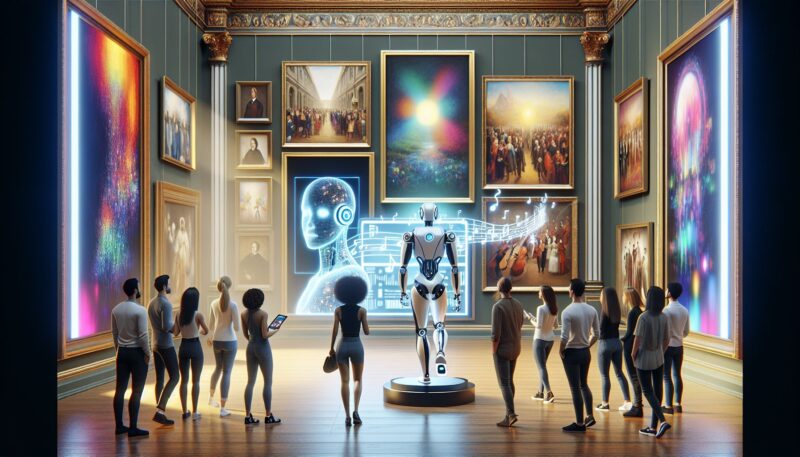
Is there anything more exciting than the feeling that a seismic shift is happening right under our noses? No, I’m not talking about the latest social media challenge or the fact that we’re all suddenly obsessed with making sourdough. I’m talking about an explosion of creativity that’s bubbling up from the intersection of technology and the arts. More specifically, the remarkable breakthroughs in Artificial Intelligence and how it’s changing creative arts. It’s like AI has finally discovered its inner Picasso!
The Age of AI-Driven Creativity
Remember the days when we thought AI was just a futuristic concept tied to robots plotting world domination or software bent on taking over your job? Yeah, me too. But the reality is way more intriguing, and way less sinister. AI’t here to replace human creativity but to boost it in ways that are changing our concept of art, music, and storytelling.
AI’s ability to generate art is nothing new. Anyone who’s been keeping up with projects like Google’s DeepDream and OpenAI’s DALL-E knows that. But there’s something different about the latest wave of AI-generated art. It’s grown up. Now, AI isn’t just copying styles; it’s creating genuinely original works that challenge our definition of art itself. It’s like AI is shedding its nerdy glasses and emerging as a hipster with an art portfolio.
The Picasso-Bot: AI in Visual Arts
Let’s look at visual arts first. AI is making waves with tools that work as a digital canvas for artists. Programs like DeepArt and Runway ML are giving artists superpowers, allowing them to blend, remix, and innovate like never before. Imagine feeding a neural network with images of Van Gogh’s Starry Night and watching it churn out a novel composition that’s both familiar and mind-blowingly unique.
The best part? AI does this at warp speed. The iterative process that might take a human months can be done by AI in mere seconds. Artists can now go on wild creative experiments without the fear of wasting time or resources. It’s like turning mistakes into masterpieces at the speed of thought.
Music to Our Ears: AI’s Sonic Symphony
Over in the music department, something magical is happening too. AI-equipped platforms like AIVA and Amper Music are co-composers, working with musicians on a thrilling creative journey. They’re crafting symphonies, scoring films, and generating catchy pop tracks that wouldn’t sound out of place on your favorite playlist. And get this—it’s not just background noise. AI is creating emotionally resonant music that can move people to tears or make them dance like nobody’s watching.
Musicians are now in this thriving partnership with AI, using the vast potential of neural networks to explore musical boundaries they couldn’t reach on their own. It’s like having an endlessly patient practice partner who’s always ready with fresh ideas. AI isn’t stealing the spotlight; it’s setting the stage for musicians to shine even brighter.
Once Upon a Time: AI in Storytelling
Storytelling is also going through a renaissance, and you bet AI’s got a quill in hand. Projects like OpenAI’s GPT-3 aren’t just about regurgitating information but about creating inventive narratives. Authors and screenwriters are collaborating with AI to break through writer’s block and generate plot twists that would make Hitchcock proud.
Imagine this: You’re crafting a fantasy novel, and you need a gripping backstory for a dragon. Enter AI, dishing out potential dragons with detailed histories like a seasoned lore-master. While human authors provide the warmth and depth, AI adds layers of complexity and unpredictability. It’s like stirring in new flavors to a classic recipe.
The Road Ahead: Challenges and Opportunities
Of course, every breakthrough comes with its fair share of challenges. The big question on everyone’s mind is: How does this affect the human aspect of art? It’s a legitimate concern that AI-generated content waters down the authenticity of human expression. But here’s a thought—it could also enrich it. Artists are redefining what it means to be a creator in a world where AI is your brush, your maestro, your muse.
There’s also the ongoing dialogue about ownership and copyright in the realm of AI-generated content. Thankfully, these hurdles aren’t insurmountable. Artists and technologists are working hand in hand to develop frameworks that protect creators’ rights while creating an environment ripe for innovation.
What happens next could redefine the creative world altogether. As AI models grow more sophisticated, the collaborative potential grows. We could be on the cusp of a Second Renaissance, one where humans and machines create together in ways we’ve never seen before.
Conclusion: The New Renaissance
As we start this thrilling adventure into the world of AI-powered creativity, it’s clear that the playground is just getting started. This breakthrough isn’t simply about adding new tools to the creative toolbox; it’s about expanding the box itself. With every canvas painted, note composed, and story told, AI is proving to be an indispensable ally in our creative evolution.
So here’s to a world where human ingenuity and machine intelligence come together to take us to uncharted creative territories. I, for one, am eagerly waiting to see what the next chapter of this techno-utopian saga will bring. And if the art world gets a little more crowded with AI Picasso-bots, well, there’s always room for more masterpieces. Keep your colors bright and your algorithms ready—our art revolution is just beginning!