
The Painting That Changed Everything (Again)
Here’s the thing about Johannes Vermeer that nobody talks about enough: he was essentially broke. When he died in 1675, his widow inherited debts that were partially tied to his pigment purchases—and that’s where it gets interesting. We’re talking about a man so committed to his craft that he was spending money he didn’t have on materials. The Getty Conservation Institute’s 2025 technical analysis of “Girl with a Pearl Earring” just confirmed something scholars have been circling around for decades: Vermeer wasn’t just a painter obsessed with light and geometry. He was a pigment obsessive, and that distinction matters.
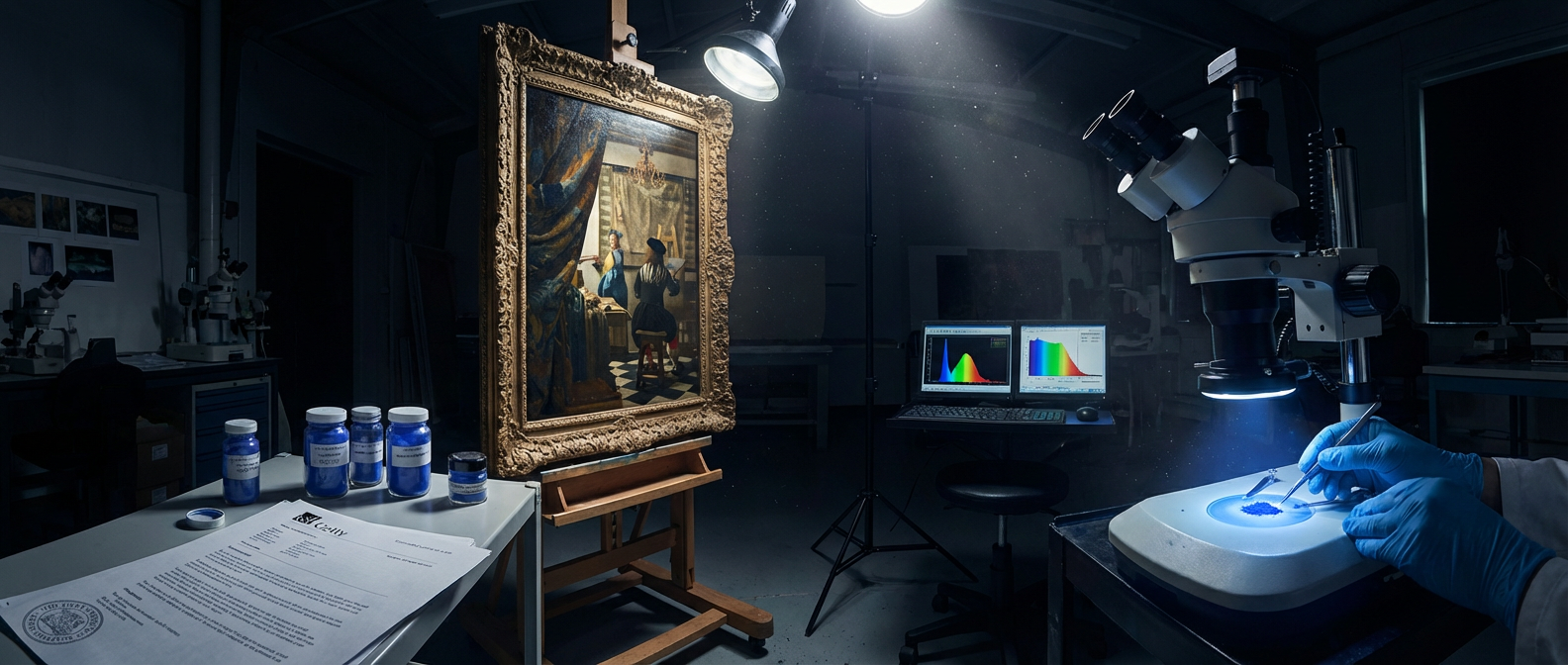
The ultramarine blue in that famous headscarf? It came from lapis lazuli sourced from Badakhshan in Afghanistan. This wasn’t a casual choice. In seventeenth-century Delft, natural ultramarine cost more per ounce than gold. Let that sink in. Gold. Vermeer was using a material more precious than the metal we’ve literally built civilizations around, applying it to a teenage girl’s headpiece in a painting that would become one of the world’s most beloved artworks. That’s not just craftsmanship. That’s a statement of values.

X-Ray Fluorescence and the Seven-Layer Revelation
The 2025 restoration findings didn’t just confirm what we thought we knew. They obliterated it. The Getty Conservation Institute Research team used X-ray fluorescence mapping to peer beneath the surface of that headscarf, and what they found was jaw-dropping: seven distinct pigment layers instead of the three that had been documented for decades. Three. That’s what previous scholarship had settled on. Three comfortable, manageable layers. But Vermeer didn’t work that way.
This is where the evangelical part kicks in, because understanding this layering technique transforms how you see not just this painting, but the entire Dutch Golden Age. Each layer represents a deliberate choice, a specific moment in the creative process. Vermeer wasn’t dabbing ultramarine onto canvas like someone filling in a coloring book. He was building it, stratifying it, creating optical depth that would catch light differently depending on the viewer’s position and the time of day. It’s the difference between understanding a painting as a finished object and understanding it as a conversation between artist and material.
The Price of Perfection: Why So Few Could Do What Vermeer Did
The National Gallery of Art’s pigment database has catalogued the practices of hundreds of Dutch Golden Age painters. Fewer than twelve of them used ultramarine at the saturation levels now confirmed in Vermeer’s work. Twelve! That’s not a stylistic preference. That’s a financial and philosophical commitment that separated the genuinely elite from everyone else working in the period. You could be a successful painter in 1670s Delft without ever touching ultramarine. You could have a thriving studio, wealthy patrons, a comfortable life. But working with pigment the way Vermeer did meant making a choice that would eventually push you into debt.
This context transforms how we read his biography. The financial struggles weren’t signs of failure or lack of patronage. They were the direct consequence of his aesthetic choices. Vermeer died relatively young, relatively poor, and relatively unknown outside his immediate circle. Only about thirty-six paintings survive, which is a shockingly small output compared to his contemporaries. But every one of those paintings is soaked in intention, in expensive pigment, in technical mastery that bordered on the obsessive. He wasn’t working faster or selling more. He was working deeper, layer by layer, with materials that cost him money he didn’t have.
The Museum Response: When Scholarship Becomes Accessible
When the Getty released its findings, something unexpected happened. The Mauritshuis Vermeer Collection in The Hague reported a 34% increase in visitor inquiries about the restoration findings within three months of publication. That’s not a subtle shift. That’s people actively seeking out this specific knowledge, wanting to understand what the research meant, wanting to see the painting through this new lens. Museums across Europe started adjusting their wall texts, their audio guides, their curatorial framing. This wasn’t just academic discourse happening in journals. This was scholarship translating into genuine public engagement.
What fascinates me is that the research didn’t make the painting more inaccessible. It did the opposite. By revealing the technical obsession behind the work, by exposing the layers and the costs and the deliberate choices, it made Vermeer’s achievement feel less like distant historical artifact and more like recognizable human ambition. Yes, he was working with materials we can’t even afford to buy today. Yes, he was operating in a world of artistic values completely foreign to ours. But the fundamental impulse, to take your vision and execute it perfectly regardless of the personal cost, that’s something contemporary audiences understand viscerally.
What This Means for How We Look at Vermeer
The Getty’s 2025 findings matter because they fundamentally challenge the narrative that has dominated Vermeer scholarship for decades. We’ve treated his small output as a limitation. We’ve framed his financial struggles as unfortunate biographical details. We’ve admired his technical mastery as something almost separate from his material choices. But all of that was incomplete. The research reveals an artist who was making conscious, intentional decisions about value and commitment at every level, from pigment sourcing to layering technique to the distribution of precious materials across a small but devastating body of work.
This is an invitation to reexamine not just Vermeer but the entire framework through which we evaluate artistic achievement. We should think more carefully about the material choices artists make, the financial costs embedded in those choices, and what those costs tell us about their priorities. Technical innovation and artistic vision aren’t separate things. And the paintings we love most were often created by people who were essentially impoverishing themselves in pursuit of perfection. If you want to understand Vermeer, you don’t just need to look at the light. You need to understand that he spent money he didn’t have on ultramarine because nothing else would do.