When Marina Abramović Meets Björk: Why the Best Art Happens Between Disciplines

The Problem With Artistic Purity

Watch any gallery opening and you’ll witness a peculiar form of segregation. The painters cluster near the wine table discussing brushwork. The video artists huddle by the projection, debating frame rates. The sculptors examine pedestals with the intensity of forensic investigators. Everyone stays in their lane, as if crossing into another medium might contaminate their artistic DNA.

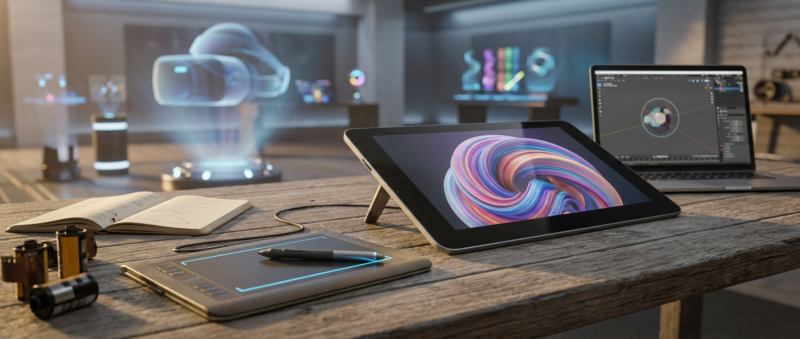
This territorial thinking ignores the most electrifying moments in contemporary art, which happen precisely when disciplines collide. Consider Marina Abramović’s 2011 collaboration with Robert Wilson on “The Life and Death of Marina Abramović.” The performance artist known for endurance pieces suddenly found herself working with opera singers, projectionists, and theatrical lighting designers. The result wasn’t diluted Abramović or compromised Wilson. It was something entirely new that neither could have achieved alone.

The Language Barrier That Isn’t

Critics love to claim that different art forms speak different languages, as if a filmmaker and a choreographer need translators to communicate. This misses the point entirely. The most interesting collaborations happen when artists discover they’re asking identical questions through different means.

Look at the ongoing partnership between filmmaker Ari Aster and production designer Grace Yun. Aster’s obsession with architectural spaces as emotional containers found its perfect match in Yun’s background in fine arts installation. Their work on “Midsommar” shows how horror cinema and spatial design can merge into something that transcends both. The film’s infamous communal dining scenes weren’t just set decoration supporting narrative. They were installations that happened to exist within a movie.

When Björk worked with digital artist Andrew Thomas Huang on her “Stonemilker” VR experience, they weren’t translating music into visuals. They were both exploring how technology can capture intimacy at impossible scales. The 360-degree beach setting wasn’t illustrating the song. It was providing another layer of the same emotional architecture Björk had constructed sonically.

The Friction Creates the Spark

The most productive collaborations aren’t smooth mergers but productive tensions between incompatible approaches. David Lynch and Angelo Badalamenti’s relationship exemplifies this perfectly. Lynch thinks in disturbing images and emotional textures. Badalamenti operates through harmonic progressions and melodic development. Their creative process for “Twin Peaks” involved Lynch describing impossible sounds while Badalamenti attempted to translate these fever dreams into playable music.

This friction forces both artists to articulate their vision in new ways. Lynch had to develop a vocabulary for discussing music that went beyond “creepy” and “beautiful.” Badalamenti had to find musical equivalents for visual concepts like “industrial decay” and “nostalgic dread.” The resulting soundtrack works as music independent of the show, while the visual elements gain emotional depth they wouldn’t possess with conventional scoring.

Similarly, when photographer Gregory Crewdson collaborates with cinematographer Rick Sands, they’re negotiating between two different relationships to time. Photography freezes a single moment into eternity. Cinematography captures movement and duration. Their large-scale staged photographs require film lighting techniques and crew structures, but the final image eliminates the temporal dimension entirely. This tension between stillness and motion gives Crewdson’s work a cinematic quality that pure photography couldn’t achieve.

Technology as Universal Translator

Digital tools have demolished many traditional barriers between mediums, but they’ve also created new forms of artistic territorialism. The painter who refuses to touch Photoshop. The musician who dismisses laptop composition. The filmmaker who fetishizes analog processes. These positions miss how technology can work as a bridge between disciplines rather than a replacement for traditional skills.

Rafael Lozano-Hemmer’s pulse installations show this bridging function beautifully. His background spans electronic art, architecture, and performance. His “Pulse Room” installation captures visitors’ heartbeats and translates them into light patterns that fill an entire space. The work succeeds because Lozano-Hemmer understands how architectural space affects human behavior, how electronic sensors can capture biometric data, and how light can create emotional atmosphere. He’s not just using technology to make art. He’s using it to connect different ways of understanding human experience.

TeamLab’s digital art installations work similarly, combining expertise in computer programming, spatial design, and interactive media. Their “Borderless” exhibitions create environments where individual artworks bleed into each other, literally showing how artificial boundaries between mediums can dissolve. A digital waterfall might flow into an animated flower garden, which transforms into a flock of digital birds. The technology doesn’t replace artistic vision. It enables new forms of collaboration between artists working in different specializations.

Beyond the Novelty Act

The danger in cross-medium collaboration lies in treating it as a gimmick rather than a genuine artistic investigation. Too many projects feel like elaborate exercises in “wouldn’t it be cool if.” The musician who commissions a visual artist to create projections for their live show. The novelist who partners with a graphic designer for an illustrated edition. These collaborations often feel additive rather than transformative.

Genuine collaborative work requires each participant to risk their established artistic identity. When William Kentridge creates his animated films, he’s not just making drawings that move. He’s discovering how the passage of time changes the meaning of mark-making itself. His charcoal erasures become temporal sculptures. His drawings exist in conversation with their own destruction and recreation.

The most lasting collaborative works create new artistic languages rather than simply combining existing ones. They establish frameworks that other artists can build upon and argue against. They expand our understanding of what each medium can accomplish by showing us what happens at their borders.

What other creative territories remain unexplored simply because we’ve accepted artificial boundaries between disciplines? The next time you encounter art that makes you slightly uncomfortable because you can’t categorize it easily, pay attention. That discomfort might be signaling something genuinely new.
Why Gagosian Shows Dead Artists While Your Local Gallery Can’t Pay Rent

The Two-Gallery Universe

Last month I watched a collector drop $80,000 on a mediocre Basquiat drawing at Gagosian while three blocks away, a scrappy project space was crowdfunding $3,000 to keep their lights on through winter. The Basquiat wasn’t even good Basquiat. But geography is destiny in the art world, and these two galleries might as well exist in different solar systems despite sharing the same zip code.

This isn’t about quality versus commerce, though that’s the easy narrative. It’s about two fundamentally different operating systems that have evolved to serve entirely different functions, yet both call themselves “contemporary art galleries.” One traffics in cultural commodities with established market values. The other gambles on ideas that don’t yet have price tags.

The Blue-Chip Machine Versus the Idea Factory

Mega galleries like Gagosian, Pace, and Hauser & Wirth function more like luxury retailers than cultural institutions. They’re selling proven assets to people who treat art like stocks, bonds, or rare wines. Their programming follows a precise calculus: estate shows of dead masters, mid-career surveys of artists with solid auction records, and carefully curated group shows that feel like investment portfolios. When David Zwirner mounted that Donald Judd retrospective in 2020, he wasn’t taking a curatorial risk. He was servicing a market.

Meanwhile, your neighborhood project space is running on fumes and passion, showing artists who might not sell a single piece during their month-long run. These galleries operate like research labs, testing hypotheses about what art can be or do. When I visited Queer Thoughts in New York last year, they were showing an artist who made sculptures from discarded medical devices. Not exactly blue-chip material, but the kind of work that pushes conversations forward in ways that another Warhol retrospective simply cannot.

The comparison reveals something crucial about how cultural value gets manufactured. Blue-chip galleries confirm existing hierarchies. Project spaces challenge them. Both are necessary, but only one gets to pay Manhattan rent without breaking a sweat.

The Curation Divide

The curatorial approaches couldn’t be more different. Blue-chip galleries curate backwards from the market, asking what their collectors want to see and own. Project spaces curate forward from ideas, asking what needs to be said right now. It’s the difference between a wine list at a Michelin-starred restaurant and a chef experimenting with fermentation in their apartment.

Consider how these two ecosystems handled pandemic programming. Major galleries pivoted to slick online viewing rooms that felt like luxury e-commerce sites. Smaller spaces got weird with it. Et al. in San Francisco started doing Instagram Live studio visits that felt more like hanging out with friends than formal presentations. The contrast was striking: one prioritized smooth commercial transactions, the other doubled down on genuine human connection.

This extends to how they discover and develop artists. Blue-chip galleries typically poach talent that’s already been vetted by smaller spaces, museums, or art schools. They’re talent acquisition, not talent development. Project spaces actually take risks on unknown quantities, often working with artists for years before anyone else notices them. Then, if those artists succeed, they graduate to bigger galleries, leaving the project spaces to start over with the next wave of unknowns.

Money Talks, But What Is It Saying?

The economics tell the real story. Blue-chip galleries operate on massive overhead but even more massive profit margins. They can afford prime real estate, full-time staff, and marketing budgets that dwarf most project spaces’ entire annual operating costs. A single sale can fund their operations for months. Project spaces hustle for grants, rely on volunteers, and celebrate when they break even.

But here’s where it gets interesting: the most innovative work often emerges from constraint, not abundance. When you have unlimited resources, why take risks? When you’re scraping together rent money, innovation becomes survival strategy. Some of the most important art of the past decade has emerged from spaces that couldn’t afford traditional gallery conventions, so they invented new ones.

The funding models also shape the programming in ways that aren’t always obvious. Blue-chip galleries answer to collectors who expect certain kinds of experiences and objects. Project spaces often rely on arts council grants that reward experimentation and community engagement. These different incentive structures produce radically different kinds of cultural experiences, even when they’re showing visual art in white-walled spaces.

The Symbiotic Tension

Here’s what makes this dynamic productive rather than just frustrating: they need each other more than either wants to admit. Blue-chip galleries require the constant injection of new ideas and artists that project spaces provide. Without that pipeline, they’d be stuck recycling the same roster of dead or aging artists forever. Project spaces, meanwhile, benefit from having a clear next level for their artists to aspire to, even if many never make it there.

The tension also creates a kind of quality control mechanism. Ideas that survive the transition from project space to blue-chip gallery have been stress-tested in ways that matter. They’ve proven they can engage both insiders and outsiders, critics and collectors, idealists and pragmatists. Not everything should make that transition, but the possibility keeps both sides honest.

The real question isn’t whether this two-tier system is fair or sustainable. It’s whether we’re paying enough attention to what each tier does well, and whether we’re supporting the right balance between them. Because when project spaces disappear, we don’t just lose individual galleries. We lose the future.

The Quiet Revolution: How Italian Arte Povera Rewrote the Rules While Nobody Was Watching

The Movement That Refused to Move

While the art world was busy genuflecting before the altar of American Pop Art and Minimalism in the late 1960s, something far more subversive was brewing in the industrial cities of Northern Italy. Arte Povera didn’t announce itself with the bombast of a Warhol soup can or the corporate sleekness of a Donald Judd cube. Instead, it whispered revolution through torn felt, live horses, and piles of coal arranged with the precision of a chess master contemplating checkmate.

The Quiet Revolution: How Italian Arte Povera Rewrote the Rules While Nobody Was Watching

The term itself, coined by critic Germano Celant in 1967, translates to “Poor Art,” but this poverty was strategic, not circumstantial. Artists like Giovanni Anselmo, Mario Merz, and Jannis Kounellis weren’t working with discarded materials because they couldn’t afford bronze or marble. They were staging a philosophical coup against the very notion that art required expensive materials to carry weight. When Kounellis filled a Rome gallery with twelve live horses in 1969, he wasn’t being theatrical for theatre’s sake. He was asking why we accept a painted horse as art but flinch when confronted with the real thing.

This wasn’t mere conceptual posturing. Arte Povera emerged from a specific moment when Italy was grappling with rapid industrialization, political upheaval, and the weight of its own artistic heritage. These artists looked at the Renaissance masters adorning every church and museum wall and said, essentially, “What now?” Their answer was to strip art down to its essential elements: energy, process, and the relationship between natural and artificial materials.

Illustration for The Quiet Revolution: How Italian Arte Povera Rewrote the Rules While Nobody Was Watching

The Alchemists of Everyday Materials

Michelangelo Pistoletto’s mirror paintings deserve more respect than they get. Starting in the early 1960s, he created works that placed photorealistic figures against polished stainless steel surfaces, creating a constant dialogue between the fixed image and the ever-changing reflection of the viewer. These weren’t Instagram-ready interactive installations designed for social media virality. They were profound meditations on time, space, and the viewer’s role in completing the artwork.

Mario Merz took this investigation of materials even further, becoming obsessed with the Fibonacci sequence and how it shows up in natural forms. His igloos, constructed from materials ranging from glass and metal to mud and twigs, weren’t primitive shelters but sophisticated explorations of growth patterns and architectural possibility. The numbers of the Fibonacci sequence, spelled out in neon across these structures, created an unexpected poetry between mathematics and intuition.

Perhaps most dramatically, Giuseppe Penone literally grew art from trees, inserting bronze casts of his own hands into young saplings and waiting years to see how the wood would grow around the metal. These “Tree of 12 Meters” works required a patience that makes contemporary art’s attention economy look positively manic. Penone was playing a decades-long game, betting that slow revelation would outlast quick sensation.

The Politics of Impermanence

What made Arte Povera truly radical wasn’t just its material choices but its relationship to permanence and the art market. These artists created works that aged, decayed, and sometimes died entirely. Anselmo’s “Untitled (Structure that Eats)” had a head of lettuce compressed between two blocks of granite, held together by a wire that would eventually break as the lettuce decomposed. The work existed fully only for a brief moment before beginning its inevitable dissolution.

This embrace of impermanence was a direct challenge to the art world’s obsession with eternal value and investment-grade objects. While American artists were busy creating works that could withstand museum conservation and art market speculation, Arte Povera artists were making pieces that actively resisted commodification. Try selling a work that includes live animals, growing plants, or materials guaranteed to decompose within months.

The political implications weren’t lost on anyone paying attention. In the context of 1960s Italy, with its student protests, worker strikes, and general questioning of established authority, Arte Povera’s rejection of precious materials and market-friendly formats was inherently political. These artists were proposing an alternative to both the capitalist art market and the socialist realist traditions that dominated leftist artistic discourse.

Why the Silence? Why the Forgetting?

The marginalization of Arte Povera in mainstream art historical narratives reveals the persistent bias toward movements that originated in New York or London. These Italian artists produced some of the most conceptually rigorous and visually compelling work of the post-war period, yet they often find themselves relegated to footnotes in surveys of contemporary art. The language barrier played a role, certainly, but so did the art world’s tendency to flatten complex regional movements into simplified categories.

Arte Povera also suffered from timing. By the time international attention turned toward Italian art in the 1980s, the focus had shifted to the brash Neo-Expressionism of artists like Francesco Clemente and Enzo Cucchi. The quiet revolution of the previous decade was overshadowed by work that photographed better and sold more easily. The art world’s short attention span, even then, favored the loud over the subtle.

More fundamentally, Arte Povera’s emphasis on process over product made it difficult to package for a market increasingly interested in recognizable signatures and consistent output. How do you create a brand around artists whose work might literally disappear or change beyond recognition over time?

The Inheritance We’re Still Discovering

Today, as contemporary artists grapple with ecological crisis, material scarcity, and questions about art’s role in late capitalism, Arte Povera looks less like a historical curiosity and more like a prescient roadmap. Artists like Tino Sehgal, who creates works entirely from human actions and interactions, or Pierre Huyghe, with his complex ecosystems that evolve beyond the artist’s control, are working in territories first mapped by these Italian pioneers.

The influence extends beyond individual practices to fundamental questions about what art can be and do. When we see contemporary artists working with organic materials, embracing chance and decay, or creating works that exist primarily as processes rather than objects, we’re witnessing the long echo of Arte Povera’s revolution.

What makes this historical moment so compelling isn’t just its artistic innovations but its willingness to imagine art beyond the structures that seemed inevitable. These artists proved that meaningful work could emerge from the most unlikely materials and methods, that profundity didn’t require expense, and that the most powerful artistic statements sometimes speak in whispers rather than shouts. Their legacy lives on not in museum collections alone but in every artist willing to question whether the conventional path is the only path worth taking.

The Unfinished Revolution: How Arte Povera Rewrote the Rules While No One Was Watching

The Movement That Refused to Move

While the art world fixated on Pop Art’s bright commercialism and Minimalism’s sterile geometries throughout the 1960s, a quiet revolution was unfolding in the industrial cities of Northern Italy. Arte Povera, literally “poor art,” emerged not with manifestos or marketing campaigns, but through the radical act of making something profound from nothing at all. Michelangelo Pistoletto arranged rags into careful compositions, Mario Merz embedded neon numbers into igloos made of bundled newspapers, and Jannis Kounellis filled galleries with live horses.

The Unfinished Revolution: How Arte Povera Rewrote the Rules While No One Was Watching

The movement’s very name, coined by critic Germano Celant in 1967, was both provocation and prophecy. These artists weren’t poor in ambition or vision. They were systematically dismantling the entire apparatus of what art could be. While their American contemporaries were busy conquering galleries with industrial materials and commercial imagery, the Arte Povera artists asked far more subversive questions: What happens when art refuses to be commodity? What emerges when process becomes more important than product?

The timing was everything. Post-war Italy was experiencing its economic miracle, transforming from agricultural society to industrial powerhouse in a single generation. Yet these artists turned away from celebration, choosing materials that spoke to impermanence, transformation, and the persistence of organic life within mechanized existence. They were creating anti-monuments for a world obsessed with progress.

The Alchemy of Ordinary Things

Giovanni Anselmo’s “Struttura che mangia” (Structure that Eats) from 1968 shows the movement’s radical approach to temporality. Two blocks of granite, held together by a head of lettuce that would inevitably rot and cause the structure to collapse, became a meditation on entropy and endurance. The work existed in a state of perpetual becoming, its meaning inseparable from its eventual destruction. This wasn’t sculpture in any traditional sense. It was philosophy made manifest through the simplest possible means.

Giuseppe Penone’s tree interventions pushed this logic even further. By inserting bronze casts of his own hands into growing trees, then returning years later to reveal the impression left in the wood, he created works that existed across decades. The artist became collaborator with natural processes, his human gesture preserved within the tree’s continuing growth. These weren’t objects to be contemplated but ongoing experiments in co-creation between human intention and organic time.

What set Arte Povera apart from other movements was its refusal to celebrate the industrial. While Minimal artists embraced steel and glass as emblems of modern efficiency, the Italian artists chose coal dust, animal fat, and growing plants as equally valid materials for artistic investigation. They weren’t rejecting technology so much as insisting on a more complex relationship with it, one that acknowledged both its promise and its limitations.

The Politics of Presence

The political dimensions of Arte Povera have been consistently underestimated by critics eager to focus on its poetic qualities. Yet the movement emerged during intense social upheaval in Italy, with student protests and worker strikes challenging established authority throughout the late 1960s. The artists’ choice to work outside commercial gallery systems and their emphasis on ephemeral materials was a direct challenge to art’s role within capitalist structures.

Piero Manzoni’s earlier provocations had prepared the ground for this challenge. His “Artist’s Breath” balloons and canned “Artist’s Shit” weren’t just conceptual pranks but systematic critiques of how artistic value gets constructed and maintained. When Arte Povera artists adopted similar strategies, creating works that couldn’t be easily bought, sold, or preserved, they were extending Manzoni’s critique into new territory.

The movement’s relationship to place proved equally subversive. While the international art world increasingly operated through global networks of dealers, collectors, and museums, Arte Povera remained stubbornly local in its concerns. The artists drew on specific traditions of Italian craftsmanship and agricultural practice, creating work that spoke to particular landscapes and communities. This wasn’t regionalism but a sophisticated form of resistance to artistic globalization.

The Paradox of Documentation

Arte Povera’s dedication to impermanence created an inevitable paradox. How do you preserve work designed to decompose? How do you market art that explicitly rejects commodification? The movement’s legacy has been shaped as much by its photographers and documentarians as by the artists themselves. Giuseppe Penone’s tree works exist now primarily as photographs, the original interventions long since absorbed into the forest.

This documentation process became its own form of artistic practice. The photographers weren’t simply recording finished works but capturing ongoing processes, creating visual records that were simultaneously inadequate and essential. The gap between experience and documentation became another material to be explored, another way of questioning how artistic meaning gets constructed and transmitted.

The irony is that Arte Povera’s anti-commercial stance eventually enabled its commercial success. By the 1980s, major collectors and museums were competing to acquire the few remaining objects and the extensive photographic documentation. The movement that had rejected the art market found itself thoroughly absorbed by it, its revolutionary gestures transformed into luxury commodities.

The Unfinished Legacy

Today, Arte Povera’s influence can be traced through countless contemporary practices, from the ephemeral installations of Felix Gonzalez-Torres to the process-based work of Eva Hesse and Robert Smithson. Yet something essential has been lost in translation. The movement’s specific relationship to Italian history and landscape, its emergence from particular economic and social conditions, cannot be simply exported to other contexts.

What remains vital is Arte Povera’s fundamental insight: that art’s power lies not in its ability to transcend material conditions but in its capacity to transform our relationship to those conditions. The movement demonstrated that revolution doesn’t require grand gestures or expensive materials. Sometimes it only requires the courage to pay attention to what everyone else is ignoring.

The questions Arte Povera raised about temporality, materiality, and artistic value have only become more urgent as environmental crisis and economic inequality reshape global culture. Perhaps it’s time to look again at these Italian artists who chose to make something beautiful from almost nothing, who insisted that art’s greatest power lies in its ability to make us see the world differently. What overlooked movements in your own cultural moment might be asking similar questions? What quiet revolutions are unfolding while we’re busy debating the obvious?

Why the Rothko Chapel Screening Changed Everything About Experimental Cinema’s Future

The Moment Everything Shifted

Three nights ago at the Rothko Chapel in Houston, filmmaker Apichatpong Weerasethakul premiered a 47-minute film consisting entirely of static shots of sleeping figures. No dialogue. No movement except for the rise and fall of chests breathing. The audience of 200 sat in complete silence for the duration, then erupted into discussion that lasted until security asked us to leave at midnight.

This wasn’t some pretentious art house stunt. It was experimental cinema finally finding its voice again after decades of either copying Lynch or chasing Sundance distribution deals. The sleeping film works precisely because it refuses to explain itself, demands nothing from viewers except presence, and somehow creates more tension than most thrillers manage with car chases.

Independent Film’s Identity Crisis

Walk into any “independent” film festival today and count how many entries look suspiciously like Netflix originals with smaller budgets. The problem isn’t funding or distribution challenges, though those remain brutal. The problem is that independent filmmakers stopped taking risks the moment they started optimizing for algorithm-friendly three-act structures and focus group-tested emotional beats.

Consider Chloé Zhao’s trajectory from the genuinely experimental “The Rider” to the Marvel-fied “Eternals.” That’s not selling out, that’s the natural progression of a system that rewards filmmakers for abandoning the very qualities that made their work distinctive in the first place. Meanwhile, true experimentalists like Jodie Mack continue creating hand-animated collages that transform junk mail into cosmic horror, screening primarily in basements and university galleries.

The split between “independent film” and “experimental cinema” has become a chasm. Independent film chases legitimacy through narrative coherence and production values. Experimental cinema embraces confusion, repetition, and the kinds of formal investigations that make film critics either ecstatic or homicidal.

What Experimental Cinema Actually Does

Last month I watched Ben Russell’s “Good Luck” at a screening in someone’s living room. It’s two hours of following a copper miner in Serbia and a copper miner in Michigan through their daily routines, shot with the kind of patient observation that makes Tarr Béla look hyperactive. The film doesn’t explain globalization or working class solidarity. It simply places two human experiences side by side and lets viewers draw connections or not.

This is what experimental cinema does that no other medium can match. It creates space for contemplation without providing easy answers. Russell’s film forces you to sit with the weight of repetitive labor, to feel time move differently, to notice details that narrative films would edit out as extraneous. It’s cinema as meditation tool rather than entertainment delivery system.

Compare this to the current crop of “experimental” features that use unconventional techniques to tell conventional stories. Films that employ split screens or non-linear editing to dress up familiar coming-of-age narratives or relationship dramas. These films mistake style for substance, treating formal innovation as seasoning rather than the main course.

The Economics of Artistic Risk

The brutal truth is that experimental filmmakers can’t afford to compromise because they’re already broke. Stephanie Barber makes films about language and perception for under $500. Her latest, “The Orangutan’s Wife,” consists entirely of voice-over narration describing films that don’t exist, accompanied by close-ups of textures and surfaces. It’s more conceptually rigorous than anything released by A24 this year and will probably be seen by fewer than 1,000 people.

This economic marginalization is actually experimental cinema’s secret weapon. When you can’t pay actors or rent proper equipment, you’re forced to discover what cinema can do with almost nothing. The constraints breed innovation in ways that million-dollar budgets rarely do. Hence the recent surge in films made entirely on phones, using found footage, or constructing narratives from security camera feeds.

Independent filmmakers trying to break into the industry face the impossible choice between artistic integrity and career viability. Experimental filmmakers sidestep this dilemma by rejecting industry viability entirely. They make films for film festivals that don’t exist yet, for audiences that might not understand them, and for reasons that have nothing to do with return on investment.

Where the Real Innovation Lives

The most exciting experimental work happening right now exists in the spaces between cinema and other disciplines. Sky Hopinka combines filmmaking with Indigenous language preservation. His films document landscapes while simultaneously documenting dying languages, creating works that function as both aesthetic experiences and cultural archives. This is cinema expanding beyond entertainment into territory that Hollywood can’t touch.

Similarly, filmmakers like Forensic Architecture use cinematic techniques to investigate human rights violations, creating works that exist simultaneously as art objects and legal evidence. Their film “The Bombing of Rafah” reconstructs Israeli military actions through architectural analysis and witness testimony, proving that experimental techniques can be powerful political tools when deployed strategically.

These filmmakers understand something that most independent film has forgotten. Cinema’s power lies not in its ability to tell stories efficiently, but in its capacity to reorganize how we perceive time, space, and reality. When experimental cinema works, it doesn’t just show us something new. It teaches us new ways of seeing.

What Comes Next

That screening at the Rothko Chapel revealed something important about where experimental cinema is headed. The audience wasn’t composed of film students or avant-garde devotees. It was architects, musicians, visual artists, writers, and people who simply wanted to experience something they couldn’t get anywhere else. Experimental cinema is finding audiences outside the traditional film world, people hungry for art that takes them seriously as thinking beings.

The question isn’t whether experimental cinema will survive in an industry increasingly dominated by algorithmic content delivery. The question is whether the film industry will notice what experimental cinema has learned about creating genuine artistic experiences in an age of infinite distraction. Some of us are betting it won’t, and that’s perfectly fine. The revolution will be livestreamed from someone’s basement, and it will be beautiful.

When Pixels Met Performance: How Digital Art Finally Escaped the Computer Screen

The Great Liberation: From Desktop Prisons to Physical Space

Remember when digital art meant screensavers and CD-ROM galleries? Those days of pixelated paradise seem quaint now that we’re living through the medium’s most explosive period of spatial evolution. The transformation isn’t just technological, it’s philosophical. Digital art has finally broken free from the tyranny of the monitor, spilling into galleries, public spaces, and interactive installations with the fervor of a medium that spent decades trapped behind glass.

When Pixels Met Performance: How Digital Art Finally Escaped the Computer Screen

Take Rafael Lozano-Hemmer’s “Pulse Room” (2006), where hundreds of incandescent bulbs flash in sync with visitors’ heartbeats, captured by a sensor interface. Compare this to early digital pioneers like Myron Krueger’s “Videoplace” (1975), which required participants to stand in front of a camera in a sterile lab environment. Both works explore human-machine interaction, but the evolution is staggering. Where Krueger’s work felt like a scientific demonstration, Lozano-Hemmer creates something approaching the sublime. A cathedral of synchronized mortality that makes your chest tighten with recognition.

The shift represents more than technical advancement. Early digital art suffered from what I call “demonstration syndrome,” the compulsion to prove that computers could make art, rather than asking whether they should. Today’s practitioners have moved past this defensive posture. They’re not justifying the medium’s existence. They’re exploring what it can reveal about our increasingly digitized existence.

Illustration for When Pixels Met Performance: How Digital Art Finally Escaped the Computer Screen

The Authenticity Wars: NFTs vs. Institutional Validation

Nothing has polarized the digital art world quite like the NFT explosion of 2021. Suddenly, everyone from your crypto-bro cousin to Christie’s auction house was pontificating about “digital ownership” and “blockchain provenance.” The art world’s reaction was predictably schizophrenic. Simultaneous horror at the environmental impact and FOMO about being left behind by a market that made Beeple’s “Everydays” worth $69 million.

But here’s where it gets interesting. While the NFT market was busy turning JPEGs into speculation vehicles, serious digital artists were having a more sophisticated conversation about authenticity and presence. Compare the sterile hype around CryptoPunks with the nuanced exploration of digital identity in Stephanie Dinkins’ “Conversations with Bina48” (2014-ongoing), where she interviews an AI robot modeled after an African American woman. Dinkins’ work raises profound questions about consciousness, race, and technology that make most NFT projects look like expensive desktop wallpapers.

The tension is productive, though. The NFT craze, for all its absurdities, forced traditional institutions to grapple seriously with digital art’s unique properties. When the Whitney Museum acquired its first NFT in 2023, Sarah Meyohas’ “Speculation,” it wasn’t capitulating to market forces. It was acknowledging that digital art’s relationship to ownership, reproduction, and authenticity demands new frameworks, not old categories.

Tools of Transformation: When Software Becomes Medium

The evolution of digital art tools tells a story of expanding possibilities and shrinking barriers. Early practitioners like Harold Cohen, who spent decades developing his AI drawing program AARON, worked in isolation with custom-built systems that required programming expertise. Today, artists can download TouchDesigner, play with machine learning models, or experiment with AR filters on their phones. Democratization brings its own complications.

Consider the work of Mario Klingemann, whose AI-generated portraits probe the uncanny valley between human and machine aesthetics. His “Memories of Passersby I” (2018) creates endless, never-repeating portraits using neural networks trained on historical paintings. Compare this to early computer art like Manfred Mohr’s geometric compositions from the 1960s, which required punch cards and mainframe access. Both artists work within computational constraints, but Klingemann operates in a world where the tools themselves are creative collaborators, not just obedient servants.

The shift from tool to collaborator is digital art’s most significant conceptual evolution. When Casey Reas writes processing code that generates unexpected visual results, he’s not just using software. He’s engaged in a creative dialogue with algorithmic systems. This partnership model has profound implications for authorship and intention in ways that would have been incomprehensible to first-generation digital artists.

Beyond the White Cube: Digital Art’s Site-Specific Revolution

The most exciting developments in digital art are happening outside traditional gallery spaces. Jenny Holzer’s LED installations have been transforming urban environments since the 1980s, but today’s practitioners are creating works that couldn’t exist anywhere else. Zach Lieberman’s interactive projections turn building facades into responsive canvases, while artists like Lauren McCarthy explore how digital systems shape social behavior in real-world contexts.

McCarthy’s “LAUREN” (2017-2019) epitomizes this site-specific approach. She replaced Amazon’s Alexa with herself, manually performing the functions of a smart home assistant for strangers’ households. The work exists in the intersection of performance, technology critique, and social experiment. Impossible to contain within gallery walls or reduce to documentation. This kind of practice makes traditional digital art look positively archaic.

The comparison with land art is instructive. Just as Robert Smithson’s “Spiral Jetty” couldn’t be moved to a museum, the most compelling digital art today is deeply embedded in specific technological and social contexts. The difference is temporal. Where land art engaged with geological time, digital art operates in the accelerated temporality of software updates and platform changes.

The Temporal Paradox: Permanence in an Age of Updates

Digital art faces a preservation crisis that would make a film archivist weep. How do you maintain an interactive installation when Flash is discontinued? What happens to net.art when browsers change? The rapid obsolescence of digital platforms creates an urgency around documentation and preservation that traditional media rarely face.

This temporal instability isn’t just a technical challenge. It’s become a defining characteristic of the medium. Artists like JODI embrace glitch and degradation as aesthetic strategies, while others like Olia Lialina excavate forgotten corners of early web culture. The medium’s ephemerality becomes part of its meaning, a built-in critique of our culture’s throwaway relationship with technology.

The question isn’t whether digital art will survive. It’s whether its essential characteristics can be preserved as the technological environment shifts beneath it. We’re witnessing the emergence of new forms of cultural memory, where preservation means constant migration rather than static storage.

These debates about authenticity, tools, space, and time aren’t just academic exercises. They’re shaping how we understand creativity in an increasingly digital world. Every gallery that installs a media wall, every artist who experiments with AI, every institution that grapples with NFTs is participating in this ongoing conversation. What aspects of this evolution do you find most compelling? Where do you see digital art pushing boundaries that other media can’t reach?

When Debut Works Demolish Conventions: Why First Efforts Often Hit Hardest

The False Mythology of the Sophomore Slump

Let’s demolish a tired piece of cultural mythology right from the start: that debut works are inherently rough drafts, promising glimpses of what an artist might eventually achieve. This backward thinking assumes creative evolution follows a neat upward trajectory, with each subsequent work building systematically on the last. But the most honest examination of artistic history reveals something far more interesting and considerably more disruptive.

When Debut Works Demolish Conventions: Why First Efforts Often Hit Hardest

Consider how Citizen Kane didn’t just announce Orson Welles as a filmmaker worth watching. It rewrote the visual grammar of cinema in 1941. Patti Smith’s Horses didn’t politely knock on punk’s door in 1975. It kicked the whole structure down and rebuilt it from the foundation up. These weren’t artists learning their craft in public. These were fully formed creative minds using their debut works to obliterate existing frameworks and establish entirely new territories.

The mythology of gradual improvement serves the comfort of critics and audiences who prefer their revolutions to arrive with proper advance notice. But real genre-reshaping debuts don’t announce themselves politely. They arrive fully armed and ready to tear down whatever came before them, often achieving in a single work what established artists spend entire careers attempting to reach.

Illustration for When Debut Works Demolish Conventions: Why First Efforts Often Hit Hardest

The Advantage of Arriving Uncompromised

Debut works carry a specific kind of destructive power precisely because they emerge from creators who haven’t yet been domesticated by industry expectations or audience demands. Take Denis Johnson’s Jesus’ Son, which didn’t just challenge conventional narrative structure in 1992. It proved that fragmented, hallucinogenic storytelling could hit harder emotionally than the tidy three-act structures that dominated literary fiction.

This uncompromising quality isn’t accidental. First-time creators operate without the accumulated weight of previous successes to protect or commercial pressures to satisfy established fan bases. They’re writing, filming, or composing for an audience that doesn’t yet exist, which paradoxically frees them to take risks that more established artists would never dare attempt. The result is work that feels genuinely dangerous. Genuinely new.

Compare this to the cautious experimentation of established artists who’ve already achieved commercial success. When Radiohead released Kid A, it was certainly bold, but it was also the calculated risk of a band that could afford to alienate some fans. When Kendrick Lamar drops an experimental album, he’s building on a foundation of established credibility. Debut artists don’t have that luxury, which is precisely why their innovations cut deeper.

Case Study: When Amateur Hour Outclasses the Professionals

Consider the curious case of Shane Carruth’s Primer, shot for $7,000 in 2004 by a software engineer with no formal film training. While established science fiction filmmakers were producing bloated, effects-heavy spectacles, Carruth created a time travel narrative so intellectually rigorous and narratively complex that it made professional efforts look like amateur sketches by comparison. The film’s deliberately opaque dialogue and ruthless refusal to explain its central concepts didn’t just challenge audience expectations. It redefined what science fiction cinema could achieve.

This wasn’t beginner’s luck. This was a creator operating from outside the established system, unburdened by conventional wisdom about what audiences supposedly wanted or needed. Carruth’s background in engineering informed an approach to narrative causality that no film school would have encouraged, precisely because it violated every accepted principle about accessibility and commercial viability.

The film’s success illustrates a key point about genre-reshaping debuts: they often emerge from creators whose primary expertise lies outside the artistic medium they’re entering. This cross-pollination brings fresh perspectives that can’t be replicated through traditional artistic training or industry experience.

The Economics of Creative Destruction

There’s an economic reality behind this phenomenon that deserves serious examination. Debut works operate under entirely different financial pressures than follow-up projects. First novels get published on smaller advances with minimal marketing budgets, freeing authors to pursue genuinely experimental approaches. Debut albums often emerge from independent labels willing to take risks that major corporations would never consider.

Look at how The Velvet Underground & Nico reshaped rock music in 1967 precisely because it was made by outsiders operating with almost no budget and zero expectation of commercial success. The album’s abrasive textures and confrontational subject matter could only have emerged from artists who weren’t trying to please existing audiences or industry gatekeepers.

This economic freedom creates space for genuine artistic risk-taking. When there’s nothing to lose, everything becomes possible. When there’s an established career to protect, conservatism inevitably creeps into creative decisions. The result is that debut works often represent the purest expression of an artist’s vision, unfiltered by the compromises that commercial success inevitably demands.

Why We Resist Recognizing Revolutionary Debuts

Perhaps the most revealing aspect of our relationship with genre-reshaping debuts is how consistently we fail to recognize them in real time. Citizen Kane was initially dismissed by many critics as technically impressive but emotionally cold. The Velvet Underground’s debut was largely ignored upon release, finding its audience only years later through cultural osmosis.

This pattern suggests something uncomfortable about how we process genuine innovation. We’re more comfortable with gradual evolution than sudden revolution, more willing to accept experimental work from artists who’ve already proven their commercial viability. Revolutionary debuts threaten our existing frameworks for understanding and categorizing creative work, which makes them inherently difficult to process and evaluate.

The critical establishment’s initial resistance to transformative debuts reveals the limitations of contemporary arts criticism, which tends to evaluate new work based on how successfully it operates within existing categories rather than how effectively it creates entirely new ones. By the time we’ve developed the critical vocabulary to properly discuss a genuinely revolutionary work, the moment of its initial impact has passed.

What other debut works do you think changed their respective mediums in ways we’re still grappling with today? The conversation around first efforts that demolished and rebuilt entire genres deserves the same intensity we bring to debating established masterworks, because these initial salvos often prove more influential than anything their creators achieve afterward.

The Beautiful Accidents: How Chaos Birthed Our Most Radical Art

When Control Meets Catastrophe

The myth of the tortured artist alone in their garret is seductive but fundamentally incomplete. What we rarely discuss is how many of our most revolutionary works emerged not from solitary genius but from spectacular failures of intention. Consider John Cage’s “4’33″” — born not from a mystical revelation about silence but from his frustrated attempts to create truly silent spaces, only to discover in Harvard’s anechoic chamber that perfect silence doesn’t exist. His own nervous system became the unwitting collaborator.

The Beautiful Accidents: How Chaos Birthed Our Most Radical Art

This collision between artistic intent and uncontrollable circumstance has produced some of the most radical works in modern history. When we trace the creative genealogy of pieces that completely altered their mediums, we find a pattern: artists setting out to solve one problem, only to stumble into solutions for entirely different questions. The accident becomes the method. The failure becomes the breakthrough.

What I find particularly fascinating is how these “accidents” reveal the inadequacy of our romantic notions about artistic creation. We want our innovators to be visionaries who saw clearly into the future of their medium. The reality is messier and far more interesting. The most radical departures often come from artists who were simply trying to make something work and discovered, in the process of failing, that the failure itself was more compelling than their original vision.

Illustration for The Beautiful Accidents: How Chaos Birthed Our Most Radical Art

The Velvet Underground’s Beautiful Mistakes

Lou Reed’s guitar tunings weren’t a calculated assault on rock orthodoxy — they were born from his inability to properly tune a guitar and his decision to embrace rather than correct this limitation. What we now recognize as the distinctive drone that defined The Velvet Underground’s sound began as Reed’s workaround for his own technical limitations. The ostrich tuning (all strings tuned to the same note) that powered “The Ostrich” wasn’t an avant-garde statement; it was the sound of someone who couldn’t be bothered to learn proper chord structures.

This practical approach to innovation extended to their collaboration with John Cale, whose classical training in minimalism met Reed’s garage-band pragmatism in ways that neither anticipated. Cale brought La Monte Young’s sustained tones and Terry Riley’s repetitive structures into contact with Reed’s street-level narratives. The result wasn’t fusion but collision — two incompatible approaches to music-making that generated entirely new possibilities.

The recording of “Sister Ray” perfectly captures this productive chaos. What we hear on White Light/White Heat is essentially a 17-minute argument between instruments, with Reed and Cale actively working against each other’s musical instincts. The session was famously contentious, but that tension became the song’s driving force. They weren’t composing; they were surviving each other’s creative impulses.

Rothko’s Crisis of Representation

Mark Rothko’s breakthrough into color field painting didn’t emerge from a coherent artistic philosophy but from a crisis of confidence in figurative representation. His subway series of the 1940s shows an artist struggling with the inadequacy of literal depiction in the face of contemporary horror. The Holocaust, Hiroshima, the mechanized violence of modern warfare — traditional artistic languages felt insufficient, even obscene.

The transition to his mature style happened during a period when Rothko was questioning whether painting itself could survive as a meaningful medium. His experiments with biomorphic forms in the late 1940s weren’t steps toward abstraction but desperate attempts to find a visual language that could contain the unspeakable. When he abandoned representation entirely, it wasn’t triumph but surrender — a recognition that what he wanted to express couldn’t be painted directly.

What we see in the great Rothko paintings of the 1950s is the residue of this struggle. Those floating rectangles aren’t decorative abstractions but compressed emotions, the visual equivalent of what remains after everything representational has been stripped away. The luminosity isn’t mystical but practical — layers of paint creating depth through light rather than perspective. The monumental scale isn’t grandeur but necessity; these works need to overwhelm the viewer’s peripheral vision to function properly.

Rothko himself was often frustrated by the spiritual interpretations of his work. He wanted viewers to experience the paintings as he had created them — as responses to specific historical crises, not timeless meditations. The chapel paintings at the Rothko Chapel represent this intention most clearly: fourteen massive canvases that function as an environment for contemplating human suffering, not transcending it.

Godard’s Revolutionary Pragmatism

Jean-Luc Godard’s jump cuts in Breathless weren’t theoretical statements about cinematic time but practical solutions to a film that was running too long. Editor Cécile Decugis simply cut out the boring bits, creating what became the most influential editing technique in modern cinema. The innovation wasn’t conceptual but editorial — a recognition that films could survive, even thrive, without traditional continuity.

This pragmatic approach to rule-breaking defined the French New Wave’s relationship to Hollywood convention. Godard and his contemporaries weren’t rejecting classical cinema out of intellectual disdain but out of economic necessity. They couldn’t afford elaborate setups, so they shot handheld. They couldn’t hire established actors, so they cast amateurs. They couldn’t build sets, so they shot on location. Each limitation became an aesthetic choice that revealed new possibilities for cinematic expression.

The famous bedroom scene in Contempt, where Brigitte Bardot and Michel Piccoli conduct their entire conversation while she dresses and undresses, emerged from Godard’s realization that the scene as written was fundamentally undramatic. By adding the physical action of dressing, he created a visual counterpoint that made the dialogue’s emotional subtext visible. The innovation wasn’t in the nudity but in the use of mundane activity to reveal character psychology.

The Generative Power of Constraints

What unites these examples is the recognition that creative breakthroughs often emerge from working within severe limitations rather than absolute freedom. The constraint becomes the catalyst. The Velvet Underground’s technical limitations forced them to find new sounds. Rothko’s crisis of representation pushed him toward a more essential visual language. Godard’s budget constraints led to a more immediate and visceral cinema.

This pattern suggests something important about the nature of innovation in art. The most radical departures don’t come from artists who set out to revolutionize their medium but from those who encounter problems that existing techniques can’t solve. They innovate not because they want to break rules but because the rules don’t provide adequate tools for what they’re trying to accomplish.

Understanding this process changes how we approach both the creation and criticism of art. Instead of looking for grand statements of artistic intent, we might pay more attention to the specific problems artists were trying to solve, the limitations they were working within, and the happy accidents that redirected their efforts. The most interesting question isn’t what the artist meant to do but what they discovered in the process of doing it.

These stories remind us that the greatest works often emerge from the intersection of ambition and accident, planning and chaos. They invite us to reconsider our assumptions about artistic genius and to pay closer attention to the messy, collaborative, often accidental processes through which new forms of expression come into being. What other “failures” in your own experience have pointed toward unexpected possibilities?

The Phantom Networks: How Underground Music Scenes Are Rewriting the Rules of Cultural Distribution

Beyond the Algorithm: Understanding True Underground Networks

The term “underground” has been so completely hijacked by streaming platforms and music blogs that we’ve lost sight of what genuine underground networks actually look like. Real underground scenes don’t operate through carefully curated playlists or influencer endorsements. They work like phantom networks, invisible webs of connection that skip traditional gatekeepers entirely. I’m talking about cassette trading circles in Eastern European basements, field recording collectives documenting disappearing soundscapes in rural America, and modular synthesizer communities building their own instruments in abandoned warehouses.

The Phantom Networks: How Underground Music Scenes Are Rewriting the Rules of Cultural Distribution

Consider the work of Seattle-based collective Sige Records, which has spent the past decade documenting the intersection of experimental noise and traditional folk forms. Their releases don’t chart on Billboard or rack up millions of Spotify plays. Instead, they circulate through a network of record stores, house shows, and academic conferences, creating a parallel economy of cultural exchange that operates completely outside mainstream metrics of success. This isn’t obscurity for its own sake. It’s a deliberate construction of alternative value systems.

What makes these networks particularly fascinating is their rejection of the attention economy that dominates contemporary culture. Unlike the performative underground posturing we see on social media, these scenes care about depth of engagement over breadth of reach. They get that true innovation requires sustained community investment, not viral moments.

Illustration for The Phantom Networks: How Underground Music Scenes Are Rewriting the Rules of Cultural Distribution

The Technology of Intimacy: Tools Creating New Sounds

The most compelling developments in underground music right now aren’t happening in professional studios or expensive software environments. They’re emerging from the creative misuse of everyday technology. Artists are circuit-bending children’s toys, running traditional instruments through broken amplifiers, and using obsolete software to create textures that would be impossible to achieve with modern tools. This isn’t some nostalgic fetish for analog warmth, but a sophisticated understanding of how technological constraints can generate aesthetic possibilities.

Take the growing movement of artists working with contact microphones and hydrophones to capture the sonic environments of urban decay and natural systems. Musicians like Jefre Cantu-Ledesma and Christina Vantzou aren’t just field recording for ambient texture. They’re developing new compositional strategies based on the acoustic properties of specific architectural spaces and ecological systems. Their work suggests that the most radical sounds might emerge not from pushing technology forward, but from listening more carefully to the world that already surrounds us.

The rise of modular synthesis communities represents another fascinating development. These aren’t gear fetishists collecting expensive toys, but communities of makers who understand electronic music as applied philosophy. They’re building instruments that embody specific theoretical approaches to time, randomness, and control. The patches they create become temporary architectures, existing only for the duration of a performance before being dismantled and rebuilt.

Genre Erosion: When Categories Become Meaningless

The most exciting underground scenes right now have completely abandoned genre categories as organizing principles. We’re seeing the emergence of what might be called “post-genre” communities that organize around methodology rather than style. These artists share approaches to improvisation, recording techniques, or collaborative processes rather than sticking to established musical forms.

The American Primitive Guitar movement, initially associated with John Fahey’s solo acoustic explorations, has evolved into something far more complex and polyglot. Contemporary practitioners like Yasmin Williams and Daniel Bachman incorporate elements of West African kora techniques, Indian classical ragas, and electronic processing into their work. They’re not trying to create fusion music in the traditional sense, but rather developing new languages that draw from multiple traditions without being bound by any of them.

Similarly, the international network of artists working in what gets loosely called “ambient music” has moved far beyond the new age associations of that term. Musicians like Klein, Gazelle Twin, and Forest Management are using ambient techniques to address urgent political and social questions, creating soundscapes that are simultaneously meditative and deeply unsettling. Their work demonstrates how experimental sound can work as cultural criticism.

The Economics of Refusal: Alternative Models of Success

Perhaps the most radical aspect of contemporary underground scenes is their development of alternative economic models that prioritize sustainability over growth. These communities understand that the attention economy is fundamentally incompatible with the kind of deep, sustained creative work they’re trying to support. Instead of competing for market share, they’re creating mutual aid networks and resource-sharing systems.

The emergence of artist-run venues, tool libraries, and recording cooperatives represents a return to the community organizing principles that powered earlier underground movements. But unlike the punk DIY ethos of previous decades, these contemporary efforts are informed by sophisticated analyses of how cultural production relates to housing policy, gentrification, and economic inequality. They’re building infrastructure rather than just staging events.

Labels like Orange Milk Records and Deathbomb Arc have developed distribution models that prioritize direct relationships with listeners over algorithmic discovery. They understand their releases as cultural objects rather than content, creating physical artifacts that reward close attention and repeated listening. This isn’t market nostalgia, but recognition that certain forms of artistic experience require different kinds of economic support.

Mapping the Unmappable: Future Trajectories

The underground scenes that will matter in the coming decade are those that understand cultural production as inherently political work. They’re developing new models of creative collaboration that challenge the individualistic mythology of the artist genius. They’re creating spaces for experimentation that exist outside the cycle of hype and backlash that drives mainstream cultural discourse.

These movements remind us that the most important cultural work often happens in spaces that resist documentation and commodification. They operate according to different timelines, developing ideas over years or decades rather than responding to the accelerated pace of social media attention cycles. They understand that true innovation requires the kind of sustained commitment that can only flourish in communities organized around shared values rather than market opportunities.

What specific underground scenes have you encountered that challenge conventional assumptions about how music should circulate and be valued? The phantom networks are always there, waiting for those willing to listen beyond the surface noise of promotional culture.

When the Underground Goes Overground: Comparing Three Decades of Local Gallery Gatekeeping

The Velvet Rope Era: How Gallery 404 Shaped Our Scene’s DNA

Walking into Gallery 404 in 1994 felt like being admitted to a secret society where the password was knowing which Cindy Sherman photograph influenced local painter Marcus Chen’s latest series. The gallery, tucked behind a Vietnamese restaurant on Bleecker Street, operated with the kind of exclusivity that made Studio 54 look like a community center. Owner Diane Kozlowski curated with surgical precision, showing perhaps twelve artists per year in a space that could barely accommodate fifteen people comfortably.

When the Underground Goes Overground: Comparing Three Decades of Local Gallery Gatekeeping

What made 404 revolutionary wasn’t its size but its obsession with context. Kozlowski refused to show work without extensive wall text that connected each piece to broader movements, often drawing lines between a local sculptor’s industrial materials and Donald Judd’s Marfa installations. This wasn’t pretension, it was pedagogy disguised as gallery practice. She understood that our scene needed education as much as exhibition, and her Saturday afternoon artist talks regularly drew crowds that spilled onto the sidewalk.

The gallery’s influence extended far beyond its physical walls. Artists began creating work specifically for Kozlowski’s consideration, knowing that her approval meant serious critical engagement rather than mere wall space. When 404 closed in 2003, it left behind a generation of artists who expected galleries to be intellectual laboratories, not just commercial spaces with white walls and wine.

Illustration for When the Underground Goes Overground: Comparing Three Decades of Local Gallery Gatekeeping

The Democratic Turn: Warehouse Collective’s Open Door Policy

Where Gallery 404 whispered, Warehouse Collective shouted. Opening in 2008 in a converted auto parts facility, the collective embraced a radically different philosophy: if you could make it to their monthly open submissions review, you had a shot at wall space. Co-founders Sarah Kim and Roberto Valdez positioned themselves as anti-gatekeepers, arguing that the local scene had become too insular, too dependent on academic credentials and gallery pedigree.

The results were predictably chaotic and occasionally brilliant. Warehouse’s group shows resembled visual cacophonies where a meticulously crafted oil painting might hang beside an assemblage made from McDonald’s wrappers and dental floss. Critics initially dismissed the space as amateur hour, but something fascinating emerged from this apparent randomness. Artists began pushing their work in unexpected directions, freed from the pressure to fit established aesthetic categories.

The collective’s monthly critique sessions, open to anyone willing to defend their work, became legendary affairs that lasted until 2 AM. These weren’t gentle community workshops but full-contact intellectual combat where ideas were tested against fierce questioning. Sarah Kim once reduced a conceptual artist to tears by systematically dismantling his installation’s theoretical framework, only to spend the next hour helping him rebuild it more coherently.

Warehouse’s democratic experiment lasted eight years, ending when gentrification priced them out of their space. But their legacy persists in the dozens of artist-run spaces that adopted their open submission model, proving that accessibility and quality aren’t mutually exclusive when paired with genuine critical engagement.

The Digital Native: Platform Gallery’s Algorithm-Resistant Curation

Platform Gallery represents our scene’s most recent attempt to solve the eternal tension between discovery and quality control. Founded in 2019 by former art critic Elena Rodriguez, Platform operates on what Rodriguez calls “slow curation”, an intentionally anti-digital approach that prioritizes sustained engagement over rapid content cycles. While Instagram stories determine which artists gain visibility everywhere else, Platform insists on showing work for minimum three-month runs.

Rodriguez learned from both her predecessors’ strengths and limitations. Like Kozlowski, she maintains rigorous selection standards, but unlike Gallery 404’s exclusive atmosphere, Platform actively courted artists working outside traditional art world networks. Like Warehouse Collective, she embraced diverse voices, but implemented a structured mentorship program that provided critical feedback without the gladiatorial atmosphere of open critiques.

The gallery’s signature innovation is its “Context Rooms”, adjacent spaces where Rodriguez displays historical works and contemporary pieces from other cities that illuminate the themes explored in the main exhibition. When local photographer James Liu showed his series documenting gentrification’s impact on small businesses, Rodriguez simultaneously displayed Walker Evans’ Depression-era storefront photographs and Zoe Leonard’s recent documentation of changing Lower East Side shop fronts.

This contextual approach has attracted national attention, with Artforum praising Platform’s ability to “localize global conversations without sacrificing intellectual rigor.” But the gallery’s real success lies in how it has influenced other local spaces to think more deliberately about historical precedents and cross-cultural dialogue.

Three Models, One Persistent Question

These three galleries represent distinct approaches to the fundamental challenge facing any cultural scene: how do you balance openness with quality, discovery with curation, local character with broader relevance? Gallery 404’s exclusivity produced artists with deep historical knowledge but limited the scene’s diversity. Warehouse Collective’s democracy generated exciting experimentation but struggled with consistency. Platform’s structured openness shows promise but remains too young for definitive judgment.

What strikes me is how each model shaped not just which art got shown, but what kind of art got made. 404’s high theoretical standards pushed artists toward conceptual sophistication. Warehouse’s anything-goes atmosphere encouraged material experimentation. Platform’s contextual framework has inspired more historically informed practice.

The comparison reveals that galleries aren’t passive venues but active creators of cultural DNA. They establish the terms of local discourse, determine which conversations matter, and ultimately influence how artists understand their own practice. Each model succeeded and failed in predictable ways: exclusivity breeds excellence but limits access, democracy encourages participation but dilutes focus, structured openness balances competing demands but risks bureaucratic stagnation.

Maybe the real question isn’t which model works best, but whether our scene needs all three approaches operating simultaneously. Maybe cultural health requires this kind of productive tension, spaces that challenge artists differently, audiences that expect different things, and curators who prioritize different values. What aspects of each model do you think our current scene most needs to embrace or abandon?