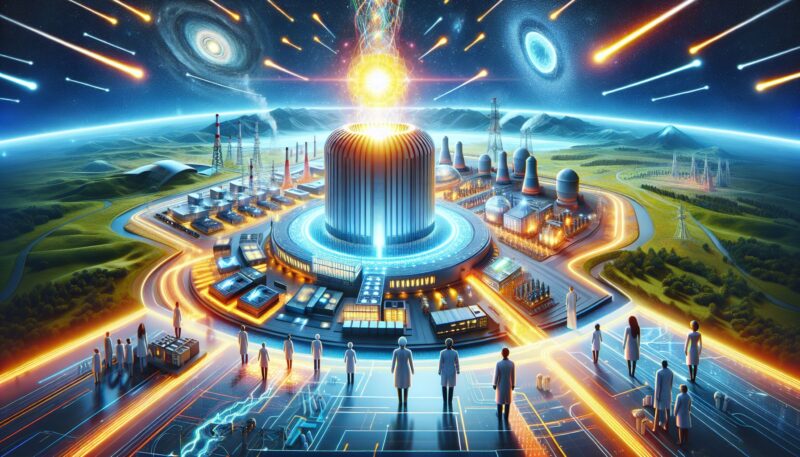
Hey tech enthusiasts! You know, we often talk about revolutionary technologies—the ones that set our hearts racing and minds dreaming. Usually, our conversations find themselves woven with threads of AI, blockchain, or longevity. But today, let’s chat about something that sounds like it belongs in a sci-fi movie, but is making waves towards reality: nuclear fusion.
What Exactly is Nuclear Fusion?
Alright, let’s start with the basics. For those of you who might’ve been dozing off in high school physics, nuclear fusion is this mind-blowingly cool process where two light atomic nuclei smoosh together to form a heavier nucleus, releasing energy. And not just a little energy—a lot. Think of the sun, that mighty ball of gas, continuously blasting energy thanks to fusion. The sun’s been at it for billions of years, so naturally, us Earthlings thought, “If the sun can do it, why can’t we?”
The catch? Replicating the conditions of the sun right here on our blue planet is no easy feat. We’re talking temperatures hotter than the surface of the sun and immense pressure. But hey, dreams that change the world often start with an impossible task, right?
The Tech Wizards Behind the Fusion Quest
Let’s take a moment to tip our hats to the fusion pioneers who refuse to accept “impossible” as part of their vocabulary. Many of you might’ve heard names like ITER, the international behemoth of a project in the south of France. It’s a collaboration of 35 countries working hand-in-hand, trying to crack the fusion puzzle. And then there’s Commonwealth Fusion Systems, backed by MIT magic, working on compact, spherical reactor designs.
Each of these players brings its own unique twist to the fusion tale. Some use magnetic confinement (think giant magnetic bottles), while others are working on inertial confinement (firing lasers at tiny fuel pellets). They may sound fancy, but at the end of the day, these are simply different roads leading us to the same destination: a future powered by nearly infinite, clean energy.
A Clean Energy Dream
Fusion power is the holy grail of clean energy—almost too good to be true! Unlike traditional nuclear fission reactors, which produce hazardous waste, fusion doesn’t churn out long-lived radioactive byproducts. I mean, sure, some residue will still need careful handling (everything can’t be perfect right out of the gate!), but nothing on the scale of today’s nuclear waste headaches.
And if you’re an environmentally conscious soul stressing over CO2 emissions, fusion’s got you covered. None. Nada. Zilch. Just a gentle reminder from Mother Nature that sometimes she loves us back.
Holding Our Horses—The Challenges of Fusion
Before we get too carried away, let’s be honest about fusion’s challenges because, let’s be real, tech utopia isn’t without some road bumps.
1. Financial Constraints: It’s expensive, folks. We’re talking billions. Fusion isn’t your run-of-the-mill startup scenario where angel investors get the ball rolling after a charismatic pitch. Getting funding often requires convincing those purse-string-holding government officials and private sector titans about fusion’s world-changing potential.
2. Timeframes: Fusion energy isn’t exactly following a Silicon Valley-esque timeline. We’re steadily pushing closer, but commercial fusion power is more like a marathon, less like a sprint. Still, each milestone is one giant leap toward this tantalizing finish line.
3. Technical Obstacles: Heating, sustaining, and containing a star on Earth isn’t walk-in-the-park stuff. From keeping the plasma stable to coping with the materials that can endure unfathomable conditions, fusion scientists often find themselves wrestling with real-world gremlins that just love meddling in theoretical beauty.
Picture This: The Future of Fusion
Now, let’s engage in a bit of future-gazing. Imagine, if you will, a world where our energy worries melt away into the annals of history. Homes powered entirely by fusion reactors, providing clean, abundant energy while our descendants clink glasses to the old-world tales of coal and oil.
This breakthrough won’t just be an energy miracle; it’s a global economic overhaul. While pushing down energy costs, it’ll flatten the playing field, inviting developing countries into the high-tech club. What’s more, if we’re serious about tackling climate change, fusion might just be the VIP pass we’ve been waiting for.
Wrapping up, I’m like a kid in a candy store when I think about what fusion means for us. Our path forward is fraught with challenges, but the horizons are shimmering with promise. To all the dreamers, tinkerers, and innovators out there, keep forging ahead. Because one day, we’ll look back at these times as the early days of a humanity powered by stars. So, what’s next? Only time, and those persistent engineers, will tell.