
The Undignified Pilgrimage
Let’s talk about what happened when Emmanuel Macron looked at the Louvre’s visitor data and felt compelled to use the word “undignified.” That’s not casual political language. That’s a president essentially admitting that the world’s most visited art museum had become something closer to a theme park queue than a place for genuine aesthetic experience. The Louvre welcomed 8.9 million people through its doors in 2024 alone, its 29th consecutive year as the most visited art museum on the planet. That number carries its own dignity problem: it suggests that experiencing art at that scale has become less about communion with a masterpiece and more about checking a box on a bucket list.
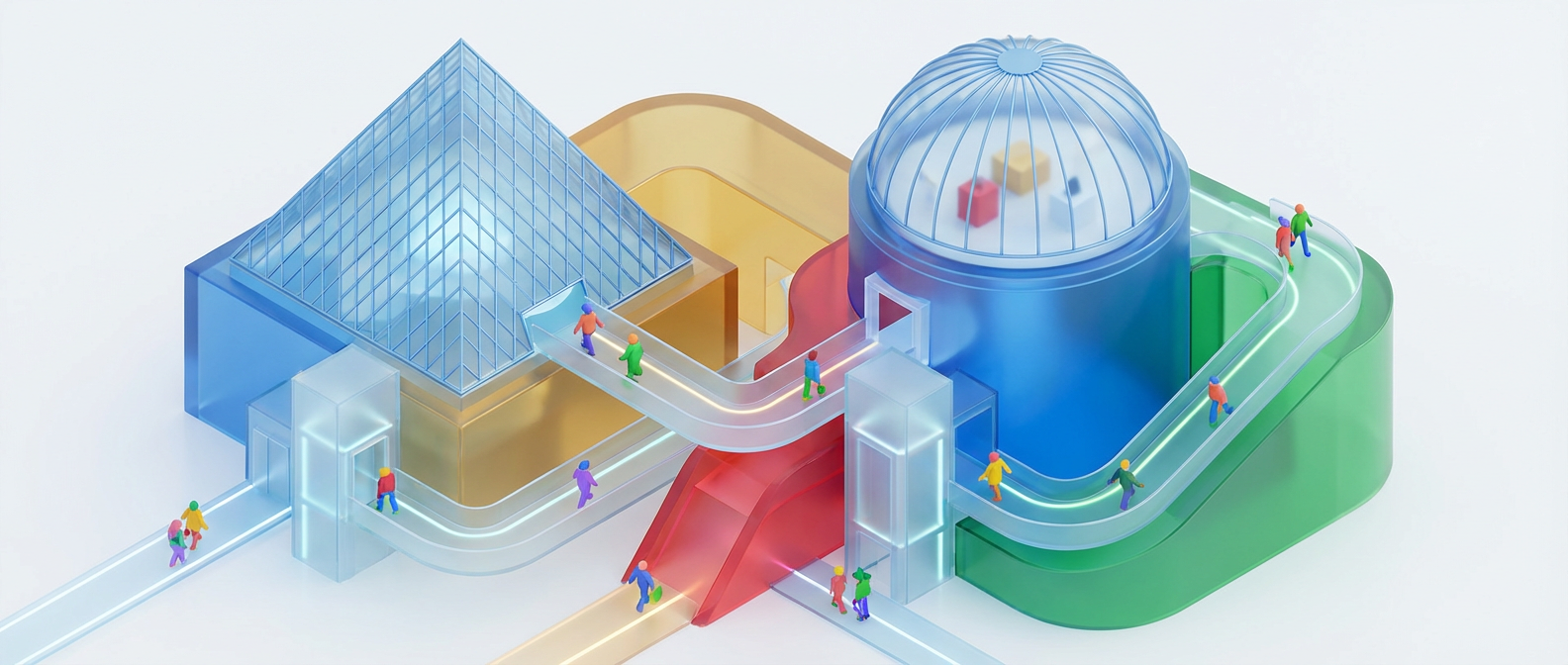
The catalyst for this conversation, of course, is the Mona Lisa. That small oil painting on poplar wood has become a prisoner of its own fame, cordoned off behind bulletproof glass in a room designed to handle crowds that would have horrified Leonardo. People stand in lines sometimes exceeding an hour just to glimpse it from the back of a throng. The image they leave with is rarely the painting itself. It’s a sea of phone screens, a collective squint, a moment that barely registers as aesthetic experience.

The Relocation Proposal and Its Precedents
The announcement that the Louvre is now seriously considering moving the Mona Lisa to a dedicated satellite venue is more interesting than simple crowd management. It’s a structural rethinking of how we organize access to the most iconic artworks in human history. The Grand Palais, that Beaux-Arts structure that just completed a €466 million renovation to serve as an Olympic venue last September, has entered the conversation as a potential home for Leonardo’s masterpiece. This isn’t random real estate speculation. The Grand Palais is positioned as a central player in how Paris distributes its cultural infrastructure going forward, and housing the Mona Lisa there would fundamentally change the cultural geography of the city.
Consider how other institutions have handled similar pressures. The Uffizi Gallery in Florence quietly limited daily visitors and implemented timed entry decades before it became standard practice. The Metropolitan Museum has used its satellite spaces and special exhibition halls to decompress its permanent collection. Yet none of these institutions faced quite the same calculus as the Louvre: how do you separate the world’s most recognizable artwork from the institution it defines, without destroying the symbolic weight of both?
The Decompression Strategy Movement
What’s genuinely fascinating is that the Louvre isn’t inventing this problem from scratch. According to recent research from the Association of Art Museum Directors Reports, 78% of major institutions are now actively investing in what they’re calling “decompression strategies” for high-traffic permanent collection works. This isn’t some niche phenomenon. It’s an industry-wide reckoning with the fact that popular artworks were never designed to handle 500 people staring at them simultaneously.
The question becomes: is moving the Mona Lisa a capitulation to capitalism and tourism, or is it actually a radical act of conservation and democratization? There’s real tension in that question. You could argue that removing the Mona Lisa from the Louvre diminishes the institution’s stature and plays directly into the hands of those who’d reduce art to portable attractions. Or you could contend that keeping it in a mob-controlled environment is the real desecration, and that offering people a genuine encounter with the painting in a less congested setting is actually the more ethical choice.
Insurance, History, and the Weight of Relocation
Here’s where the historical context matters. The Mona Lisa hasn’t left the Louvre since 1974, when it made a celebrated journey to Tokyo and Moscow. That’s fifty years of rooting in Paris. The painting is insured at an estimated $870 million, which means any move involves logistical and security considerations that most artworks never face. Yet that very isolation has created its own mythology. The longer the painting stays in one place, the heavier it seems to become in the cultural imagination.
Museums have historically used rotation and relocation as tools of artistic renewal. When major institutions loan paintings temporarily, it often refreshes both the borrowed work and the lending collection. The Louvre understands this principle, yet the Mona Lisa presents a unique challenge because its location has become part of its meaning in ways that most artworks don’t experience. Move it, and you’re not just changing rooms. You’re rewriting a relationship between a masterpiece and a city.
What This Means for Art Accessibility
The Grand Palais proposal deserves serious consideration precisely because it could accomplish something genuinely radical: creating conditions under which more people see the Mona Lisa properly rather than simply seeing it. A dedicated space at a renovated major venue could implement controlled access, quieter viewing environments, and contextual presentation that the current Louvre location simply cannot accommodate. You’d trade the symbolic weight of encountering the painting within the historical collection for the practical gift of actually encountering it.
Yet this also exposes deeper anxieties about art accessibility right now. Are we solving a problem or just its symptoms? The crowd at the Mona Lisa isn’t really a crowd of art lovers. It’s a crowd of tourism demographics, a mixture of genuine curiosity and algorithmic destination marketing. Moving the painting might create a better viewing experience for those motivated enough to seek it out, but what about the person who travels to Paris once in their life and expects the Louvre to deliver its most famous treasure? You’ve now introduced a secondary decision, a branching path through cultural tourism that privileges certain kinds of preparation and knowledge.
This is the conversation worth having. The Louvre’s crisis isn’t really about the Mona Lisa. It’s about what we expect from museums in an age of mass tourism, what we owe to both preservation and access, and whether some artworks have become so culturally weighted that moving them actually liberates rather than damages them. The answers aren’t obvious, and they shouldn’t be. What’s your instinct on this? Does separating the Mona Lisa from its home feel like necessary triage, or like surrendering to the very forces that have made authentic art experience increasingly difficult to find?