
The Moment Everything Changed
Let’s establish the obvious first: 133.5 million people watched Kendrick Lamar perform at Super Bowl LIX in New Orleans, making it one of the most-watched halftime performances in NFL history. But here’s what matters more than the viewership numbers, which the league will certainly weaponize in their quarterly reports. What we witnessed was not entertainment in the traditional sense. This was a political art statement executed with such precision and historical literacy that it functioned as a public intervention, a Trojan horse disguised as a pop culture moment. The NFL had no idea they were hosting what amounts to the most significant commentary on American mythology to hit a mainstream platform in years.

The thing about major institutions is that they rarely understand the art they’re sponsoring. They see the celebrity, count the eyeballs, and declare victory. They don’t see the apparatus of critique being constructed around them in real time. Kendrick didn’t just perform songs. He deconstructed the very stage he was standing on, and the network broadcasting it to half the country still thinks they successfully contained the moment.
Visual Language as Political Statement
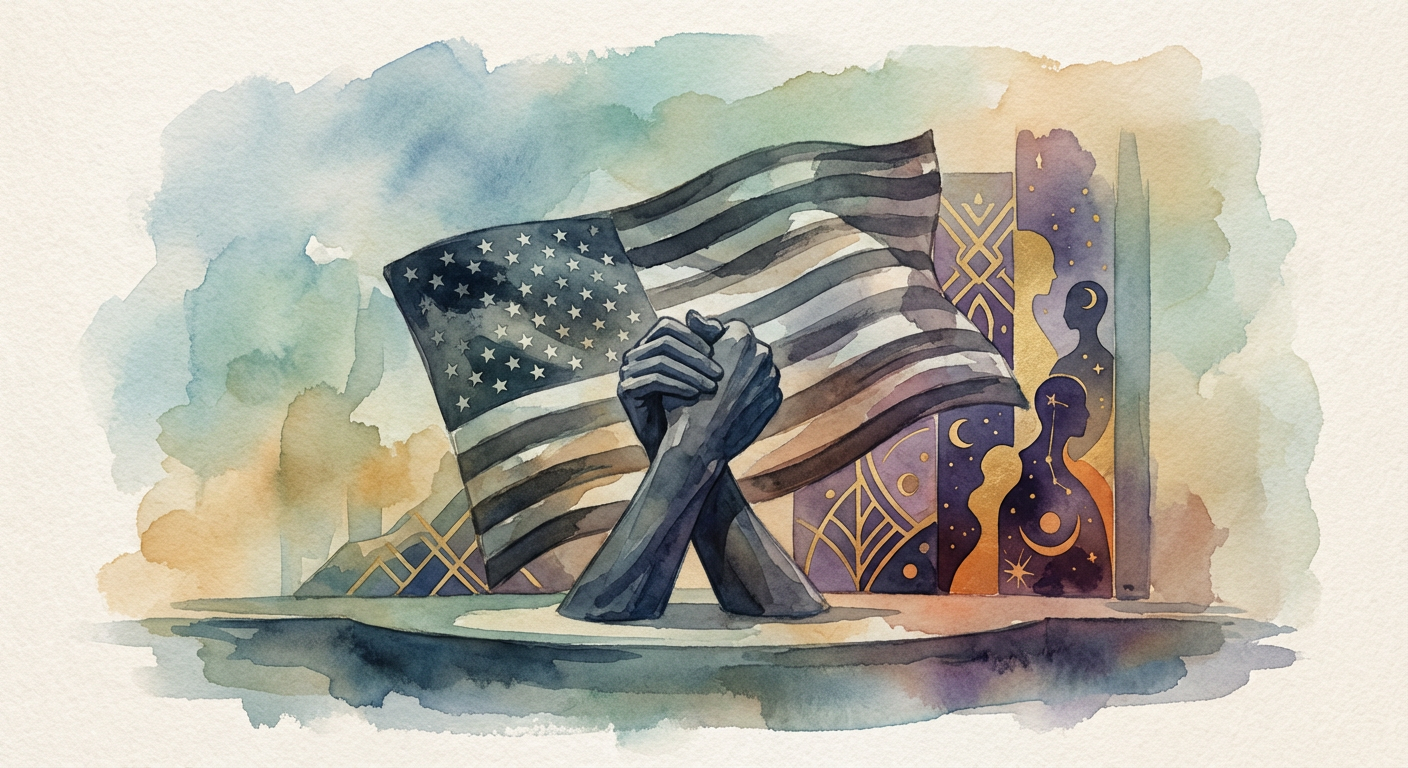
The staging incorporated Black American flag imagery throughout the performance, a deliberate invocation of Hank Willis Thomas’s “The Embrace” public art tradition and Afrofuturist visual vocabulary. This wasn’t decoration. This was an argument being made in real time to a massive audience that had tuned in expecting spectacle and instead got pedagogy. The Black flag exists outside the comfortable discourse of patriotism that the NFL typically wraps around its halftime broadcasts. It speaks to refusal, to alternative imagining, to the possibility that American identity itself might need dismantling and rebuilding from scratch.
Consider the context: the Super Bowl is perhaps the most aggressively patriotic American sporting event outside of military propaganda films. The national anthem, the fighter jets, the whole apparatus designed to make you feel like consuming entertainment is somehow a civic duty. Kendrick didn’t protest this directly. He occupied the space with an entirely different visual language, one rooted in Black radical traditions and artistic practice. The flag imagery connected his work to decades of Black artistic intervention, from the Black Arts Movement through contemporary galleries. It transformed the stadium into something that resembled a political art installation more than a football halftime show.
Samuel L. Jackson appeared throughout the performance as a narrator character, functioning as what cultural critics at The Atlantic’s cultural analysis of the halftime show described as a living embodiment of the American mythology Kendrick was actively deconstructing. Jackson’s presence wasn’t ceremonial. It was ironic, critical, and deeply knowing. He was the voice of a certain kind of Americanism, canonical, performed, institutionalized, being challenged by the music and visuals surrounding him. The juxtaposition created meaning that went entirely unnoticed by most mainstream sports media.
The Diss Track as Grammy-Winning Art Form
Kendrick performed “Not Like Us” twice during the set. This song won the 2025 Grammy for Record of the Year, making it the first diss track ever to win that award. This fact alone deserves to sit with you for a moment. The Recording Academy essentially canonized the diss track, the form that hip-hop has always understood as the highest expression of lyrical contest and cultural critique, within the same institutional framework that typically sanitizes art into something safer and more palatable.
The double performance wasn’t redundant. It was an insistence. The first time felt like inclusion in the halftime show structure. The second felt like interruption, like Kendrick saying: “I’m not finished with this. The argument continues.” The diss track by definition refuses resolution. It lives in critique, in naming names, in making specific cultural interventions that won’t be forgotten or smoothed over. By performing it twice, Kendrick was asserting that this mode of cultural work belongs on the biggest stages, regardless of whether mainstream institutions are prepared to recognize its validity.
The Streaming Numbers Tell an Incomplete Story
The data reveals something genuinely fascinating: Nielsen streaming surge data post-Super Bowl showed a 1,400% surge in streams of Lamar’s back catalog in the 48 hours following the halftime performance. That’s not just the halftime show becoming an advertisement for new material. That’s people being moved to go back and investigate, to situate what they just saw within Kendrick’s larger body of work, to understand the full architecture of what he’s been building for years.
What this means is that the halftime show functioned exactly as serious art does. It didn’t stand alone as a moment of entertainment consumption. It created an opening that made people want to think harder, dig deeper, engage with a broader context. That’s the opposite of what the NFL typically accomplishes. They present isolated moments designed to be consumed and forgotten, to fragment your attention into discrete units. Kendrick created something that demanded integration, that asked audiences to hold together multiple pieces of information and history.
Why the NFL Still Doesn’t Understand What Happened
The NFL will report record viewership and call this a victory. They’ll commission think pieces about how the halftime show remains a vital institution in American culture. They will not grapple with the fact that Kendrick used their platform to make an argument about American mythology that fundamentally challenges the patriotic consensus they were trying to build around the broadcast. This is how institutional co-option works. You give the artist a massive platform. They make something genuinely critical and powerful. The institution celebrates the viewership metrics and calls it all a success for everyone involved.
But something happened in New Orleans that can’t be contained or controlled retroactively. Kendrick created a template for what a mainstream platform can be used for when you have sufficient artistic vision and cultural authority. He demonstrated that you don’t have to reject institutional space — you can occupy it with intention, with history, with a fully realized political and aesthetic argument. He took the halftime show form and revealed it as something with genuine capacity for art. The NFL thinks they hosted a spectacle. They actually hosted something closer to a gallery intervention, and 133.5 million people walked through it whether they realized what they were seeing or not.
The question now is whether other artists will understand what Kendrick has shown is possible. Will they use these massive platforms for genuine critique, or retreat to the safer business of entertainment? That’s worth watching. The halftime show has real stakes again.