The Committee That Ate Itself
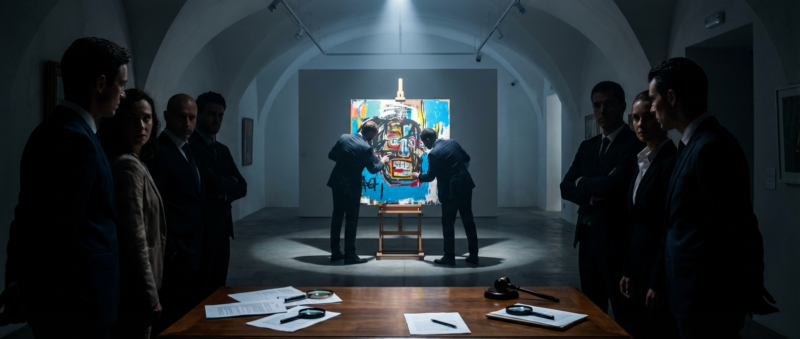
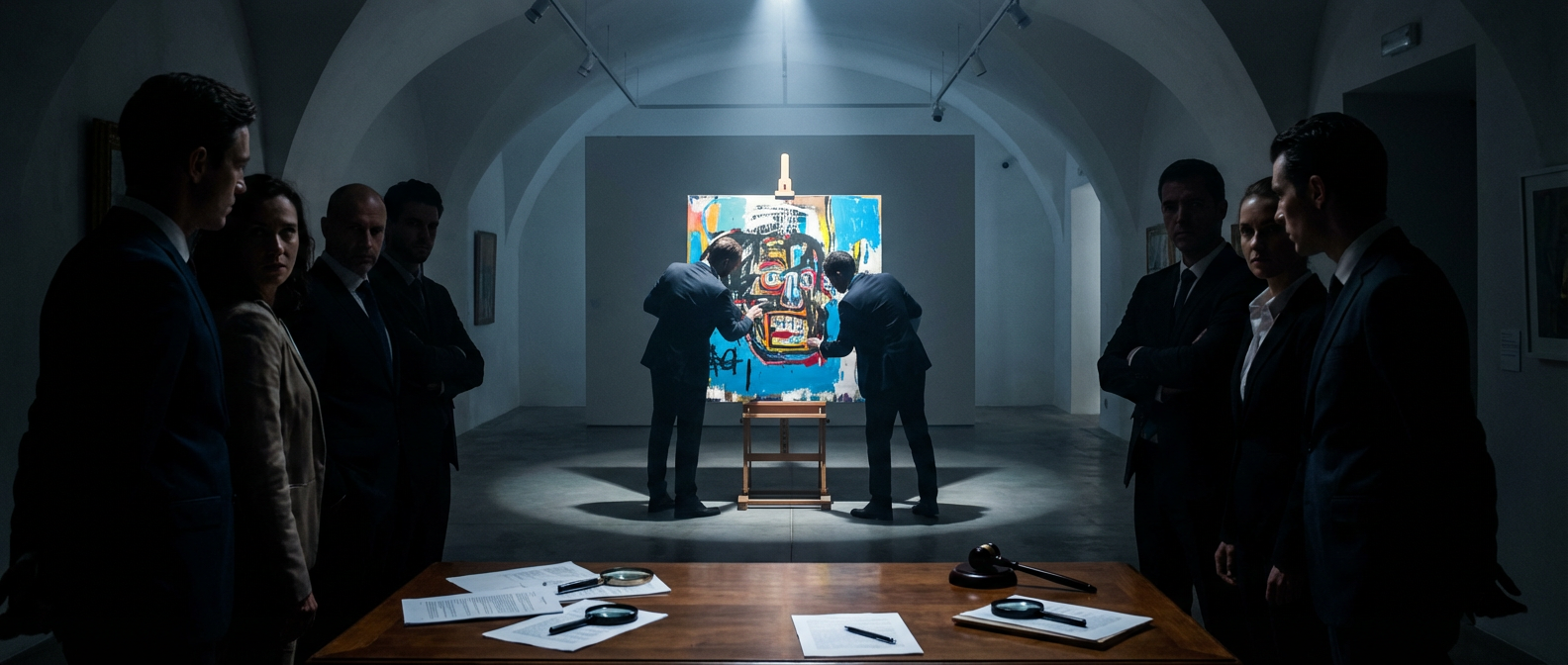
The art world’s most prestigious authentication body just committed institutional suicide, and frankly, it was long overdue. The Basquiat Authentication Committee, that ivory tower tribunal that spent decades rubber-stamping million-dollar paintings with the confidence of papal infallibility, disbanded this January after spectroscopic analysis revealed what any skeptical observer should have suspected: over one-third of their blessed artworks contained materials that didn’t exist when Jean-Michel Basquiat was alive.
Think about that staggering figure for a moment. Thirty-four percent. This isn’t a statistical margin of error or a few rogue dealers slipping fakes past drowsy experts. This is a systematic failure so profound it makes the art market’s previous authentication scandals look like minor clerical errors. The committee’s Basquiat Estate Official Statement reads like a corporate apology crafted by lawyers who’ve already calculated settlement costs.
What’s particularly damning is how long this charade persisted. The committee operated with the kind of clubby exclusivity that the art world adores, where reputation mattered more than rigorous scientific analysis. Members built careers on their supposed ability to divine authenticity through connoisseurship alone, as if aesthetic intuition could somehow detect molecular composition. The arrogance is staggering, even by art world standards.

When Titanium White Became the Smoking Gun
Dr. Elena Rodriguez’s forensic laboratory became the scene of the art world’s most expensive autopsy. Her spectroscopic analysis didn’t just find irregularities. It found eighteen authenticated Basquiat paintings containing titanium white pigments that weren’t commercially available until 1993, five years after the artist’s death from a heroin overdose. This wasn’t subtle detective work requiring advanced degrees in art history. This was basic chronology.
Rodriguez’s findings expose the authentication committee’s fundamental flaw: their reliance on stylistic analysis over material evidence. While committee members debated brushwork and compositional elements, forgers were literally using the wrong ingredients, like cooking a Renaissance feast with ingredients from a modern supermarket. The Art Authentication Technology Report details how spectroscopic analysis has revolutionized forgery detection, making old-school connoisseurship look increasingly outdated.
The titanium white discovery is more than scientific advancement. It’s a symbol of the collision between tradition and technology in art authentication. For decades, the market operated on educated guesses dressed up as expertise. Now, molecular-level analysis can definitively date materials, revealing the emperor’s complete lack of clothes. Rodriguez didn’t just identify forgeries, she demolished an entire methodology built on assumptions and insider knowledge.
The $2.1 Billion Pause Button
Sotheby’s decision to suspend sales of 127 Basquiat pieces worth approximately $2.1 billion is the art market’s equivalent of a bank run. When the world’s most prestigious auction house essentially admits it can’t guarantee the authenticity of works it previously championed, confidence evaporates faster than turpentine in an open studio.
This suspension creates a fascinating paradox. The very works that commanded astronomical prices due to their supposed rarity and authentication are now radioactive precisely because of authentication concerns. Collectors who spent fortunes on committee-approved pieces now find themselves holding potentially worthless canvases, while genuinely authentic works remain trapped in limbo pending new protocols.
The ripple effects extend far beyond individual collectors. Insurance companies, galleries, and auction houses built entire business models around the committee’s authority. Now they’re scrambling to develop new verification systems while managing existing inventory of questionable provenance. It’s a masterclass in how institutional credibility, once lost, creates cascading market failures.
Legal Warfare and the Estate Strikes Back
The Basquiat estate’s lawsuit against 23 galleries across New York and London signals a new phase in this scandal. These aren’t polite requests for documentation review. They’re full-scale legal assaults targeting galleries for selling works with fraudulent provenance documentation. The estate argues that these institutions either knowingly participated in fraud or were criminally negligent in their due diligence.
What makes these lawsuits particularly significant is their scope. They span both sides of the Atlantic, targeting blue-chip galleries that built reputations on their expertise and connections. The legal strategy appears designed to hold the entire distribution network accountable, from authentication committees to auction houses to retail galleries. It’s a systematic dismantling of the infrastructure that enabled this fraud.
The insurance angle adds another layer of complexity. Claims related to Basquiat forgeries reached $847 million last year, representing a 340 percent increase from the previous year. Insurance companies are now requiring increasingly sophisticated authentication before issuing policies, effectively creating parallel verification systems outside traditional art world institutions. The days of insuring artworks based solely on expert opinions are ending.
The Authentication Revolution That’s Already Here
This scandal arrives at a moment when technology is fundamentally reshaping art authentication. Spectroscopic analysis, X-ray fluorescence, and radiocarbon dating provide definitive answers to questions that previously relied on educated speculation. The Basquiat committee’s dissolution doesn’t just represent institutional failure, it marks the end of an era when human expertise alone could determine authenticity.
The broader implications extend beyond individual artists or even the contemporary art market. Every authentication committee, every expert opinion, every institutional blessing now faces scrutiny. Collectors and institutions are demanding scientific verification rather than accepting traditional connoisseurship. This shift represents the art world’s long-overdue embrace of empirical evidence over insider authority.
What emerges from this chaos won’t be prettier or more romantic than the old system, but it will be more honest. Scientific authentication eliminates the cozy relationships and subjective judgments that enabled systematic fraud. It replaces the art world’s traditional reliance on reputation with verifiable data. The romance of connoisseurship dies, but the integrity of the market has a chance to live.
The Basquiat authentication scandal is more than financial fraud or institutional failure. It’s a reckoning with the art world’s resistance to transparency and accountability. As lawsuits unfold and new protocols emerge, we’re witnessing the painful birth of a more scientific, less mystical approach to art authentication. The question isn’t whether this transformation will continue, but whether traditional institutions can adapt quickly enough to survive it.