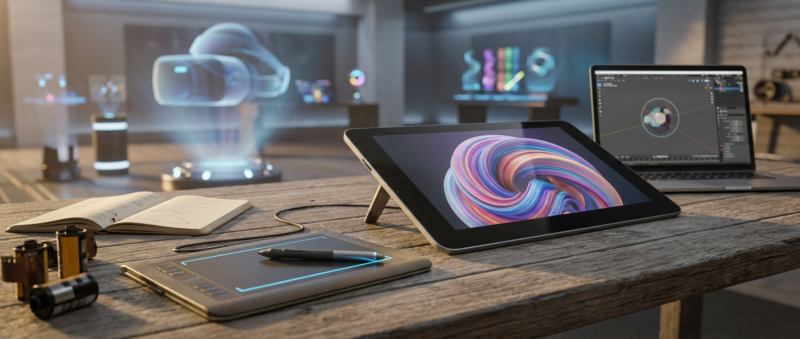
The Great Liberation: From Desktop Prisons to Physical Space
Remember when digital art meant screensavers and CD-ROM galleries? Those days of pixelated paradise seem quaint now that we’re living through the medium’s most explosive period of spatial evolution. The transformation isn’t just technological, it’s philosophical. Digital art has finally broken free from the tyranny of the monitor, spilling into galleries, public spaces, and interactive installations with the fervor of a medium that spent decades trapped behind glass.
Take Rafael Lozano-Hemmer’s “Pulse Room” (2006), where hundreds of incandescent bulbs flash in sync with visitors’ heartbeats, captured by a sensor interface. Compare this to early digital pioneers like Myron Krueger’s “Videoplace” (1975), which required participants to stand in front of a camera in a sterile lab environment. Both works explore human-machine interaction, but the evolution is staggering. Where Krueger’s work felt like a scientific demonstration, Lozano-Hemmer creates something approaching the sublime. A cathedral of synchronized mortality that makes your chest tighten with recognition.
The shift represents more than technical advancement. Early digital art suffered from what I call “demonstration syndrome,” the compulsion to prove that computers could make art, rather than asking whether they should. Today’s practitioners have moved past this defensive posture. They’re not justifying the medium’s existence. They’re exploring what it can reveal about our increasingly digitized existence.
The Authenticity Wars: NFTs vs. Institutional Validation
Nothing has polarized the digital art world quite like the NFT explosion of 2021. Suddenly, everyone from your crypto-bro cousin to Christie’s auction house was pontificating about “digital ownership” and “blockchain provenance.” The art world’s reaction was predictably schizophrenic. Simultaneous horror at the environmental impact and FOMO about being left behind by a market that made Beeple’s “Everydays” worth $69 million.
But here’s where it gets interesting. While the NFT market was busy turning JPEGs into speculation vehicles, serious digital artists were having a more sophisticated conversation about authenticity and presence. Compare the sterile hype around CryptoPunks with the nuanced exploration of digital identity in Stephanie Dinkins’ “Conversations with Bina48” (2014-ongoing), where she interviews an AI robot modeled after an African American woman. Dinkins’ work raises profound questions about consciousness, race, and technology that make most NFT projects look like expensive desktop wallpapers.
The tension is productive, though. The NFT craze, for all its absurdities, forced traditional institutions to grapple seriously with digital art’s unique properties. When the Whitney Museum acquired its first NFT in 2023, Sarah Meyohas’ “Speculation,” it wasn’t capitulating to market forces. It was acknowledging that digital art’s relationship to ownership, reproduction, and authenticity demands new frameworks, not old categories.
Tools of Transformation: When Software Becomes Medium
The evolution of digital art tools tells a story of expanding possibilities and shrinking barriers. Early practitioners like Harold Cohen, who spent decades developing his AI drawing program AARON, worked in isolation with custom-built systems that required programming expertise. Today, artists can download TouchDesigner, play with machine learning models, or experiment with AR filters on their phones. Democratization brings its own complications.
Consider the work of Mario Klingemann, whose AI-generated portraits probe the uncanny valley between human and machine aesthetics. His “Memories of Passersby I” (2018) creates endless, never-repeating portraits using neural networks trained on historical paintings. Compare this to early computer art like Manfred Mohr’s geometric compositions from the 1960s, which required punch cards and mainframe access. Both artists work within computational constraints, but Klingemann operates in a world where the tools themselves are creative collaborators, not just obedient servants.
The shift from tool to collaborator is digital art’s most significant conceptual evolution. When Casey Reas writes processing code that generates unexpected visual results, he’s not just using software. He’s engaged in a creative dialogue with algorithmic systems. This partnership model has profound implications for authorship and intention in ways that would have been incomprehensible to first-generation digital artists.
Beyond the White Cube: Digital Art’s Site-Specific Revolution
The most exciting developments in digital art are happening outside traditional gallery spaces. Jenny Holzer’s LED installations have been transforming urban environments since the 1980s, but today’s practitioners are creating works that couldn’t exist anywhere else. Zach Lieberman’s interactive projections turn building facades into responsive canvases, while artists like Lauren McCarthy explore how digital systems shape social behavior in real-world contexts.
McCarthy’s “LAUREN” (2017-2019) epitomizes this site-specific approach. She replaced Amazon’s Alexa with herself, manually performing the functions of a smart home assistant for strangers’ households. The work exists in the intersection of performance, technology critique, and social experiment. Impossible to contain within gallery walls or reduce to documentation. This kind of practice makes traditional digital art look positively archaic.
The comparison with land art is instructive. Just as Robert Smithson’s “Spiral Jetty” couldn’t be moved to a museum, the most compelling digital art today is deeply embedded in specific technological and social contexts. The difference is temporal. Where land art engaged with geological time, digital art operates in the accelerated temporality of software updates and platform changes.
The Temporal Paradox: Permanence in an Age of Updates
Digital art faces a preservation crisis that would make a film archivist weep. How do you maintain an interactive installation when Flash is discontinued? What happens to net.art when browsers change? The rapid obsolescence of digital platforms creates an urgency around documentation and preservation that traditional media rarely face.
This temporal instability isn’t just a technical challenge. It’s become a defining characteristic of the medium. Artists like JODI embrace glitch and degradation as aesthetic strategies, while others like Olia Lialina excavate forgotten corners of early web culture. The medium’s ephemerality becomes part of its meaning, a built-in critique of our culture’s throwaway relationship with technology.
The question isn’t whether digital art will survive. It’s whether its essential characteristics can be preserved as the technological environment shifts beneath it. We’re witnessing the emergence of new forms of cultural memory, where preservation means constant migration rather than static storage.
These debates about authenticity, tools, space, and time aren’t just academic exercises. They’re shaping how we understand creativity in an increasingly digital world. Every gallery that installs a media wall, every artist who experiments with AI, every institution that grapples with NFTs is participating in this ongoing conversation. What aspects of this evolution do you find most compelling? Where do you see digital art pushing boundaries that other media can’t reach?