The Laboratory Behind the Noise
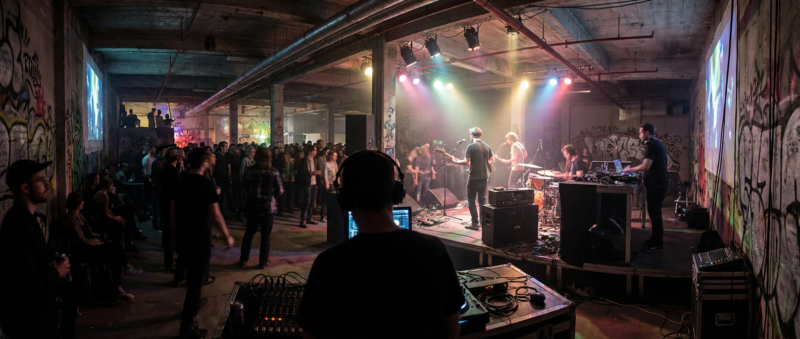
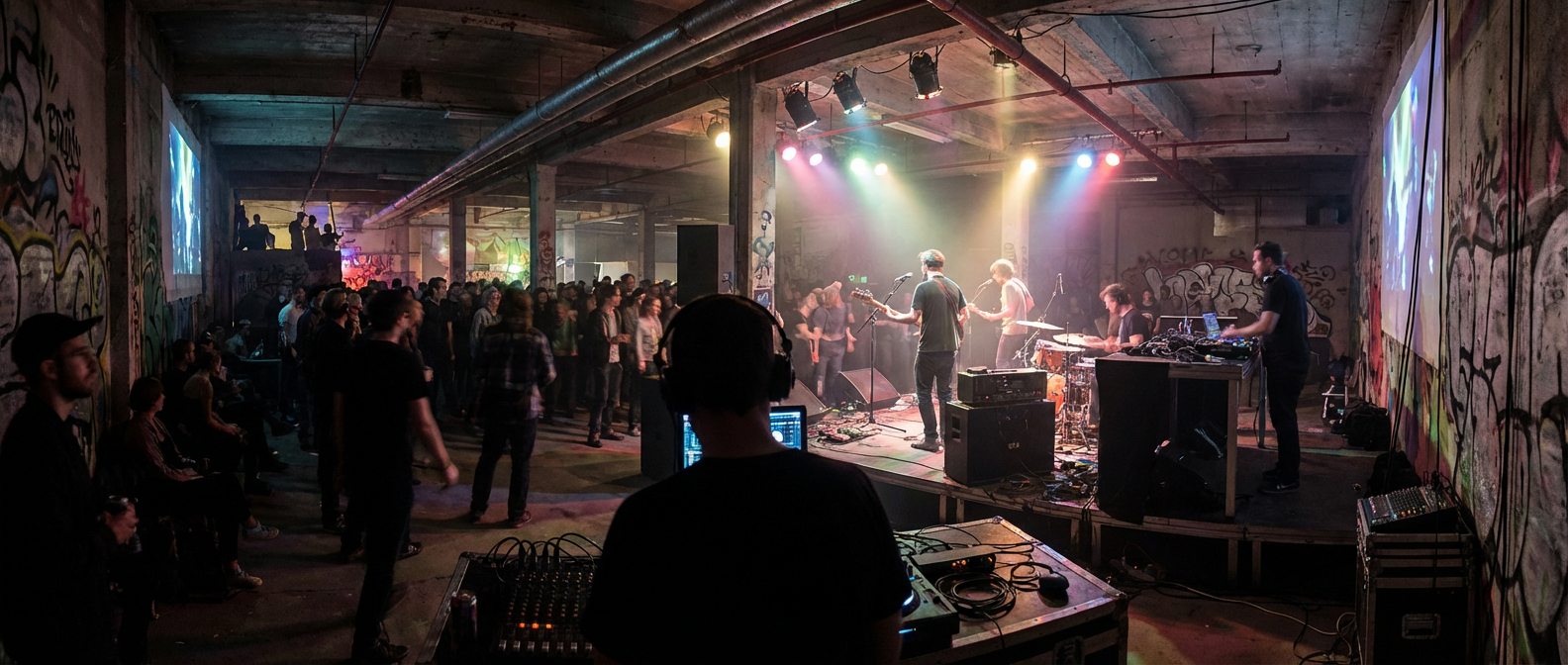
Walk into any proper underground recording space and you’ll immediately understand why the best music emerges from basements, abandoned warehouses, and repurposed storage units rather than pristine studios with gold records on the walls. The creative process happening in these spaces works on completely different principles than mainstream production. Where commercial music follows predictable templates (verse, chorus, bridge, repeat), underground artists are conducting sonic experiments that would make John Cage proud.
Take the approach of Chicago’s industrial collective Sculpture Club, who record exclusively using found objects and broken equipment. Their process begins not with songwriting but with what they call “material archaeology.” Founder Maya Chen spends weeks collecting discarded electronics, metal scraps, and damaged instruments, then spends months learning the unique sonic properties of each piece. A dying amplifier doesn’t get repaired. It gets explored for the specific frequency distortions it produces in its death throes.
This methodology reveals something fascinating about underground music creation: it puts discovery over delivery. While mainstream producers chase proven formulas, underground artists chase accidents, malfunctions, and the spaces between intended sounds. The process becomes as much about unlearning conventional techniques as mastering new ones.

Collaborative Chaos and Intentional Friction
The most compelling underground music rarely emerges from solitary genius but from collaborative processes designed to generate productive conflict. Portland’s experimental hip-hop collective Fractal Syntax has developed what they term “antagonistic composition.” Each member must actively work against the others’ musical instincts rather than harmonizing with them.
Their albums begin with individual members creating completely incompatible backing tracks in different time signatures, keys, and tempos. Then comes the real work: finding connection points not through compromise but through collision. Drummer Kenji Nakamura describes it as “forcing puzzle pieces from different boxes to somehow fit together.” The result is music that retains the tension of its creation process, where every resolution feels hard-won rather than inevitable.
This approach extends to recording techniques that deliberately introduce instability. Many underground artists have abandoned the clinical precision of digital recording in favor of methods that inject unpredictability into every step. They route signals through custom-built circuits that respond to room temperature, record onto deteriorating magnetic tape, or use software they’ve deliberately corrupted. The goal isn’t lo-fi aesthetics for their own sake but the integration of chance operations into the fundamental DNA of the music.
Tools as Co-Creators, Not Servants
The relationship between underground musicians and their tools reveals another key difference from mainstream production practices. Rather than using technology to realize predetermined visions, underground artists often allow their tools to become co-creators, equal partners in the compositional process. This represents a philosophical shift from technology as servant to technology as collaborator.
Berlin-based sound artist Petra Holz has spent three years developing a modular synthesizer system that she never fully controls. Her patches incorporate random voltage generators, chaotic oscillators, and feedback loops that ensure no performance can be exactly repeated. But this isn’t musical Russian roulette. It’s a highly disciplined practice of creating structures loose enough to accommodate the unexpected while tight enough to maintain artistic coherence.
The craftsmanship here lies not in technical perfection but in building frameworks for controlled chaos. Holz spends months programming complex probability matrices that determine how her system will respond to various inputs, then dedicates equal time to developing the listening skills necessary to hear potential music in whatever emerges. She’s crafting not just sounds but new ways of musical thinking.
This approach extends to software tools as well. Underground producers regularly modify, break, and rebuild their digital instruments, treating coding as another form of composition. They write custom algorithms that generate rhythmic patterns based on weather data, create virtual instruments that degrade over time like physical objects, or design effects that respond to the emotional content of input audio. The boundary between composition, performance, and instrument building dissolves entirely.
Time as Material, Patience as Technique
Perhaps the most radical aspect of underground music creation is its relationship to time. While commercial music operates under market pressures that demand rapid output and instant gratification, underground artists often work on geological timescales. They treat time itself as a compositional material to be shaped and manipulated.
Drone metal pioneers like Seattle’s Earth have elevated this to an art form, but the principle extends far beyond any single genre. Japanese sound installation artist Hiroshi Kumagai works exclusively on pieces designed to be experienced over multiple visits, with compositions that evolve so slowly that changes are barely perceptible in real time. His recording process mirrors this temporal expansion: sessions that last entire seasons, with microphones left running to capture the subtle acoustic changes as rooms age and weather patterns shift.
This extended temporality allows for creative processes impossible within commercial constraints. Ideas can germinate for years before finding expression. False starts become integral parts of the final work rather than waste to be discarded. The act of patient observation (of sounds, spaces, and one’s own creative impulses) becomes as important as any technical skill.
Documentation as Transformation
The final element distinguishing underground music creation is how documentation itself becomes a transformative act rather than mere preservation. Underground artists approach recording not as capturing performance but as creating entirely new works that exist only in documented form.
This manifests in practices like “studio composition,” where the final piece exists only as a studio construction, impossible to recreate in live performance. Artists layer incompatible elements, manipulate time through editing, and create spatial relationships that exist only in the stereo field. The recording becomes the composition, not its documentation.
Some artists take this further, treating post-production as primary creation. They record raw sessions with no predetermined structure, then spend months in editing, finding the hidden compositions buried within hours of improvisation. The craft lies in learning to hear potential music within apparent chaos, developing editorial instincts that can transform accident into intention.
These methodologies challenge fundamental assumptions about what music is and how it should be made. They suggest that the most vital creative work happens not in pursuit of predetermined goals but in the patient exploration of uncharted sonic territories. As mainstream music becomes increasingly predictable, these underground laboratories continue pushing into genuinely unknown creative spaces.
What underground processes are you most curious about exploring? The intersection of these experimental methodologies with emerging technologies promises even more radical departures from conventional musical thinking.